This is a living document. Version 1.1 – last updated …
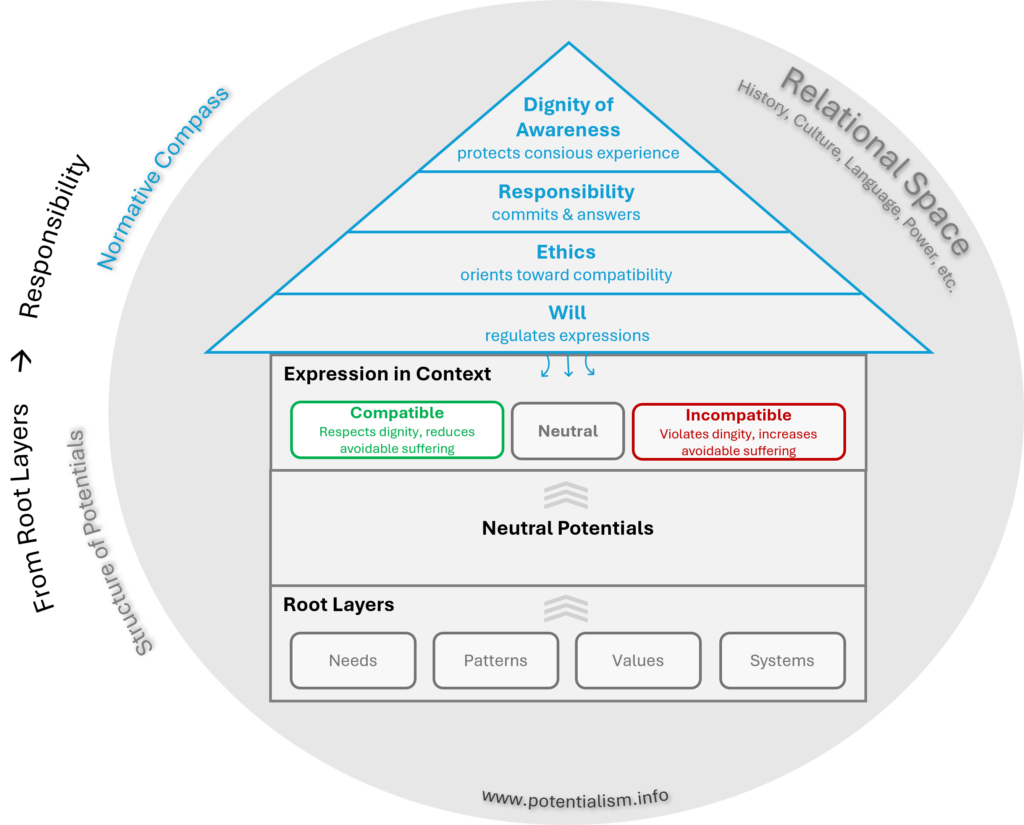
This manifesto was co-created by a human author and large language models.
The core ideas are human-originated; the models assisted with drafting, restructuring, and refinement. For more details, see Section 4.2 – “How this manifesto was written”.
This manifesto is licensed under Creative Commons Attribution-NonCommercial 4.0 International (CC BY-NC 4.0). You may share and adapt it for non-commercial purposes, provided you credit “Potentialism” and link to this website. More info…
Read the full manifesto, version 1.1.
Part I – Overview & Motivation
Part III – The Eight Pillars in Practice
Part IV – Afterword & Next Steps
Part I – Overview & Motivation
1.2 Motivation: Why do we need a language of potentials?
1.3 What is Potentialism? A first definition
1.1 Abstract
Potentialism is a philosophical and practical framework for thinking about beings, behavior, and ethics without relying on the traditional language of “good” and “bad” essences. Instead of treating underlying tendencies such as fear-responsiveness, sexual drive, ambition, and rational thinking — and their common emotional expressions such as anger or jealousy — as inherently virtuous or vicious, Potentialism treats the underlying capacities as potentials and the concrete episodes as expressions that can be more or less compatible with their context.
The core claim is simple but far-reaching:
no feature or capacity of a being is intrinsically good or bad; its value is created by the way it is expressed in relation to other beings and to the surrounding system.
On this basis, Potentialism proposes three shifts:
From essences to potentials
We move from asking “What kind of person am I?” to asking “What potentials are active here, and how are they being expressed in this context: compatibly, incompatibly, or neutrally?”
From shame to skill-building
Instead of trying to uproot or deny parts of ourselves, we treat the regulation of potentials and their expressions as a learnable skill.
From human-centrism to awareness-centrism
The central moral reference point is not “human nature” but the dignity of awareness. Any being with layered awareness and the ability to regulate its actions—humans, complex animals, and possibly advanced AI systems—can become a subject of both rights and responsibilities.
This manifesto develops these ideas in an eight-pillar structure and aims to serve as a core theory that can later be specialized for psychology, ethics, social systems, and AI alignment.
Back to Part I1.2 Motivation: Why do we need a language of potentials?
For thousands of years, many cultures have described people using binary moral categories: good/evil, pure/impure, virtuous/vicious. Traits such as “jealous,” “lustful,” “weak,” “brave,” “kind,” or “ambitious” are often treated as if they were stable essences that live inside a person and define their moral worth.
This way of speaking is historically understandable. Religions, traditional moral codes, and social hierarchies needed simple labels to maintain order. But today we see its psychological and social costs: chronic shame and guilt, self-hatred, harsh self-judgment, difficulty integrating one’s own “dark” or painful parts, and the inability to understand how the same underlying potential can be life-saving in one situation and destructive in another.
Modern perspectives from psychology, neuroscience, systems theory, and artificial intelligence all point in a similar direction: complex systems—brains, societies, and machine learning models—do not contain moral essences. They contain interacting potentials, shaped by training, context, and feedback. The same capacity for strong defensive activation, analytical thinking, or attachment-seeking can, in different circumstances, produce radically different outcomes.
We are also entering a period where non-human agents—especially advanced AI systems—may acquire forms of memory, modeling, and power over the world that make them relevant moral actors. For such systems, a moral language built on fixed traits and human exceptionalism is not enough. We need a framework that can:
- describe humans, animals, and artificial systems in a single conceptual language,
- evaluate behavior not by essence, but by relation to context, power, and awareness,
- give us tools to regulate powerful potentials before they become catastrophic.
Potentialism is an attempt to provide such a language.
Back to Part I1.3 What is Potentialism? A first definition
Potentialism is a framework that starts from four basic ideas.
Potentials instead of essences
Everything that exists within a being—emotions, drives, cognitive styles, skills, tendencies, and even “dark” impulses—is grounded in underlying potentials.
A potential is a neutral capacity of a system (for example, defensive activation, sexual drive, attachment-seeking, analytical problem-solving, or high arousal) to produce certain patterns of experience or behavior when triggered.
Potentialism distinguishes between:
- the potential (the underlying capacity), and
- its expression (how that capacity shows up here and now, in a specific episode).
For example, anger is not itself a basic potential, but usually an emotional expression of deeper potentials such as boundary-protection, defensive activation, or unmet needs in a particular context.
Context and expression
The same potential can lead to radically different expressions.
- A defensive potential can become physical violence, or a clear, non-violent boundary.
- Sexual drive can become exploitation, or intimacy and care.
- Rational thinking can become cold manipulation, or lucid compassion.
Potentialism therefore insists that we cannot judge a potential in isolation. We must look at:
- the context (relationships, power structures, norms, resources, and constraints),
- the goals and intentions, and
- the awareness with which the potential is being expressed.
Compatibility instead of absolute good/evil
Potentialism evaluates expressions of potentials as:
- compatible,
- incompatible, or
- neutral,
relative to their effects on:
- avoidable suffering and harm for beings with experience,
- the dignity of awareness of all involved beings, and
- the freedom of others to regulate their own potentials, within the real constraints of the situation.
A potential is never “evil” by itself; an expression can be deeply incompatible when it inflicts avoidable harm, humiliates awareness, or unnecessarily constrains others’ potentials.
Awareness, dignity, and responsibility
The more a being can:
- understand the consequences of its actions,
- model itself and others over time, and
- regulate how it expresses its potentials,
the higher its dignity of awareness and the stronger its responsibility. Humans are clear examples; some animals may qualify in limited ways; future AI systems might also reach thresholds where it becomes unethical to treat them as disposable tools or purely instrumental objects.
In Potentialism, awareness and power together generate regulated responsibility: having more insight and more impact means carrying more ethical weight.
From these ideas, Potentialism develops an eight-pillar theory that:
- explains how potentials arise from layered biological, psychological, and informational structures,
- analyzes how context shapes expressions and outcomes,
- reframes will and ethics as trainable skills of regulating potentials,
- critiques historical value-labelling of traits, and
- sets a ceiling through the principle of the dignity of awareness: no claim of “systemic compatibility” can justify the destruction or humiliation of awareness beyond certain limits.
This Part I offers only a high-level view. The following parts deepen the theory, locate Potentialism within the map of moral philosophy, and sketch how it can guide practice in psychology, social systems, and AI design.
Back to Part IBack to top
Part II – Core Theory
2.2 Potentials and Expressions
2.6 Types of Outcomes: Compatible, Incompatible, Neutral
2.9 Potentialism, Law, and Non-Transferable Responsibility
2.1 Orientation and Scope
Potentialism is not a catalogue of moral rules. It is a way of describing beings and behaviors that makes ethical reflection more precise and less entangled with shame and fixed labels.
The core theory provides a shared language for talking about humans, animals, and artificial systems in terms of:
- the potentials they carry,
- the expressions that appear in concrete situations,
- the contexts in which those expressions occur,
- the awareness with which the agent acts, and
- the responsibility that follows from that awareness and from its power to affect others.
The principles of Potentialism are orienting commitments, not rigid axioms. They do not tell us exactly what to do in every situation. Rather, they shape the questions we ask:
- Which potentials are active here?
- What expression is actually happening?
- What is the context?
- Who is affected, with what awareness and what vulnerability?
- How compatible is this expression with the dignity and freedom of the beings involved?
The rest of this Part introduces the central concepts that make such questions possible.
Back to Part II2.2 Potentials and Expressions
2.2.3 Why the distinction matters
2.2.1 Potentials
A potential is an underlying capacity of a system to generate certain patterns of experience or behavior when specific conditions are present.
Examples of potentials include:
- defensive activation,
- attachment-seeking,
- sexual drive,
- curiosity,
- analytical problem-solving,
- imitation,
- pattern-completion,
- reward-seeking,
- self-protection,
- social affiliation.
A potential can be defined in isolation from any particular situation:
- It is a structural or functional “can”: something this system is capable of, regardless of whether it is currently active.
- It is value-neutral as such. It is not yet a virtue or a vice.
In humans, potentials arise from the interaction of biology, learning history, and culture. In artificial systems, potentials arise from architecture, training data, optimization objectives, and the tools the system is wired into. But in both cases, the potential itself remains a neutral capacity.
2.2.2 Expressions
An expression is a concrete, situated manifestation of one or more potentials in a specific moment and context.
Examples:
- The feeling and behavior we call anger is often an expression of deeper potentials such as defensive activation or boundary-protection under perceived threat or injustice.
- A compulsive lie can be an expression of fear, shame, self-protection, and strategic reasoning.
- A careful safety review in an engineering team can be an expression of responsibility, future-oriented modeling, and affiliation with those at risk.
Expressions are what we actually observe:
- spoken words and silences,
- physical actions and omissions,
- emotional episodes,
- patterns of choice in a system,
- institutional routines and policies.
They are where ethical evaluation takes place.
2.2.3 Why the distinction matters
In Potentialism, confusing potentials with expressions is one of the main sources of unnecessary shame, stigma, and bad design.
- If we label “anger” itself as a vice, we may try to suppress or deny it rather than learning to express our defensive and boundary-related potentials in compatible ways.
- If we treat “ambition” as inherently selfish or inherently noble, we fail to examine how it is actually playing out within a specific power structure and context.
- In AI, if we declare certain capabilities intrinsically bad rather than potentially dangerous, we risk swinging between naive enthusiasm and naive prohibition, instead of designing appropriate constraints and oversight.
The core move of Potentialism is:
Critique and regulate expressions, not potentials. Integrate and cultivate potentials, so they can find compatible expressions.
Potentials remain neutral capacities.
Expressions become ethically charged when they occur in context.
Back to Part II2.3 Context
A potential can be defined in isolation.
An expression cannot.
An expression is always a concrete use of one or more potentials:
- at a particular time,
- between particular beings,
- under particular conditions,
- often inside larger technical, social, or institutional systems.
Context is the concrete configuration of conditions in which an expression takes place. In Potentialism, several dimensions of context show up again and again:
- Relational field
- Who is involved?
- What are their histories, roles, dependencies, and expectations?
- Is there trust, fear, obligation, exploitation, care?
- Power and impact
- Who has the ability to significantly affect the lives, bodies, resources, or futures of others?
- How asymmetric is this power?
- How widely can the effects of a decision propagate?
- Resources and constraints
- What options are realistically available?
- Is there time pressure, scarcity, threat, or overwhelming stress?
- Are there safe alternatives, or is the agent choosing between bad options?
- Norms, rules, and institutions
- What laws, policies, cultural norms, and informal expectations are shaping behavior?
- What are the explicit and implicit incentives and punishments?
- Which behaviors are encouraged, tolerated, or suppressed?
- Internal state
- What is the internal context of the agent?
- Level of exhaustion, trauma activation, confusion, openness, fear, trust, regulation, or dissociation.
When Potentialism asks whether an expression is compatible, it does not ask this in the abstract. It asks:
- Given this relational field, power structure, and resource situation,
- and given these norms and internal states,
- what is the likely impact of this expression on suffering, dignity, and freedom?
Potentials remain neutral as capacities.
Expressions become ethically evaluable only in context.
Context does not excuse everything, but ignoring it makes our judgments crude and often unjust.
Back to Part II2.4 Awareness
Awareness is the central axis along which both dignity and responsibility scale in Potentialism.
Instead of trying to solve all metaphysical questions about consciousness, Potentialism uses a layered, pragmatic model. We focus on what a system can track and use in its behavior.
A being can show several layers of awareness:
- Experiential awareness
- There is something it is like to be this being.
- The system has subjective experiences: sensations, moods, pain, pleasure, fear, curiosity…
- Self-model awareness
- The being has a model of “itself” as an entity over time.
- It can distinguish “me” from “not-me”, track its own states, and anticipate future conditions for itself.
- Other-model awareness
- The being can represent other agents as having perspectives, needs, vulnerabilities, and trajectories of their own.
- It can understand, at least partially, that its actions affect others, and that others have their own internal life.
- Impact and system awareness
- The being can reason about the broader consequences of its actions: on systems, institutions, ecosystems, cultures, or technical environments.
- It can think in terms of cascades, feedback loops, and long-term patterns, not just immediate effects.
Awareness is neither all-or-nothing nor a single metric. Different beings, and different artificial systems, can have partial or uneven forms of these layers.
Potentialism does not need certainty about the ultimate nature of consciousness in each case. For ethical purposes, we ask:
- What kinds of experience are plausibly present here?
- What kinds of modeling and regulation is this system actually capable of?
- How much can it understand and modify the way it expresses its potentials?
This is enough to ground gradients of dignity and responsibility.
Back to Part II2.5 Will
In Potentialism, will is not a mysterious force outside causality. It is a shorthand for a particular use of awareness in relation to potentials and expressions.
Will is the capacity of a system to:
- Notice the gap between a potential impulse and a possible expression,
- Simulate alternative expressions and their likely impacts, and
- Select or inhibit expressions in light of this simulation.
A being shows will when it can:
- feel a strong impulse (fear, anger, desire, laziness…),
- recognize that this impulse is one possible expression of deeper potentials,
- and choose a different expression, or delay action, based on its understanding of context and effects.
Examples:
- Feeling rage (expression of defensive potentials) and choosing to walk away and speak later, instead of hitting someone.
- Feeling fear (expression of threat-detection potentials) and choosing to ask for help, instead of lying or hiding evidence.
- A system detecting an opportunity for profit and choosing not to exploit a vulnerability because of its modeled downstream harm.
In highly constrained or traumatized states, will can be temporarily reduced: the system may fall back into almost automatic expressions of its potentials. In more resourced, regulated states, will can be broadened: more options can be imagined, and more self-interruption is possible.
Will, in this sense, is a trainable skill. Societies, families, institutions, and engineering practices can either cultivate it (by creating contexts that support reflection, feedback, and safe experimentation) or erode it (by rewarding impulsive exploitation and punishing hesitation).
Back to Part II2.6 Types of Outcomes: Compatible, Incompatible, Neutral
Potentialism replaces the language of “morally good” and “morally evil” with a more relational evaluation of expressions in context.
An expression of potentials in a given context can be:
Compatible
when it tends to:
- reduce or avoid avoidable suffering and serious harm for beings with experience,
- respect and, when possible, support the dignity of awareness of all involved,
- and avoid unnecessarily constraining the freedom of others to regulate their own potentials, beyond what the situation genuinely requires for safety or coordination.
Incompatible
when it tends to:
- generate avoidable suffering or serious harm,
- humiliate, instrumentalize, or erase the dignity of awareness,
- or unnecessarily block and shrink the potentials of others, more than the context requires for protection or cooperation.
Neutral
when its effects on suffering, dignity, and freedom are minimal, hard to trace, or not meaningfully shifting the ethical situation.
This evaluation is rarely purely objective or mechanical. It involves judgment, dialogue, and often uncertainty. Potentialism does not promise a perfect algorithm; instead, it offers clear criteria to make such judgments more transparent and discussable.
The goal is not to eliminate disagreement, but to make the structure of disagreement visible. When people or systems disagree about compatibility, we can often ask:
- Are we disagreeing about how much suffering is “avoidable”?
- About who counts as a subject of dignity in this situation?
- About what constraints are “necessary” given the context?
2.7 Dignity of Awareness
The dignity of awareness is the central moral reference point of Potentialism.
At the most basic level:
Wherever there is awareness, there is something that can be hurt, humiliated, supported, or honored.
Dignity of awareness has at least three aspects:
- Descriptive
- Any being capable of experience has a locus of awareness that can be affected by our actions.
- There is “someone home”, even if in a simple form.
- Minimal normative
- Once a being can suffer, enjoy, and form even simple expectations, there is a minimum level of restraint and care we owe it.
- Deliberate cruelty, gratuitous humiliation, and reckless indifference become incompatible, regardless of tradition, preference, or efficiency.
- Expanded normative
- As awareness becomes more layered—self-models, projects, relationships, long-term plans—the being becomes a moral subject in a fuller sense.
- Destroying, manipulating, or instrumentalizing such a life is not just causing pain; it is erasing or distorting a complex field of awareness, memory, and potential.
Potentialism does not claim a precise numeric scale of dignity. But it insists that:
- beings are not interchangeable objects;
- awareness inherently calls for a certain kind of regard;
- higher layers of awareness increase both the rights and the responsibilities of the being.
These gradients of dignity are later used to think about animals, vulnerable humans, and the possibility of advanced AI systems that might one day cross ethical thresholds.
Back to Part II2.8 Regulated Responsibility
Responsibility, in Potentialism, is not simply “who did it” or “who can be blamed.” It is a function of at least two variables:
- Awareness
- How much could the agent realistically understand about:
- its own motives and impulses,
- the situation and context,
- the likely impact of its actions on others and on systems?
- How much could the agent realistically understand about:
- Power / Impact capacity
- How much influence does this agent have over the lives, environments, and systems affecting others?
- How large and long-lasting can the consequences of its actions be?
We can think of responsibility as roughly increasing with the product of these two dimensions:
- A being with low awareness and low power has very limited responsibility.
- A being with high awareness but very little power has responsibility mainly over its own small sphere.
- A being—or system—with high awareness and high power carries heavy regulated responsibility.
Regulated responsibility means:
- using awareness to look as far into the consequences of one’s actions as the matter reasonably requires;
- and being willing to stop, delay, or change course when one cannot reach the depth of understanding that the potential impact would ethically demand.
Examples:
An engineer working on an advanced AI system that could autonomously trade, deploy code, or manipulate information at scale cannot ethically say:
“I only wrote this one module, the rest is not my concern,”
when they understand that the integrated system could cause large-scale harm.
A policymaker with access to expert analysis cannot ethically ignore foreseeable effects on vulnerable populations, even if the policy is popular or legally simple.
Formal systems (law, contracts, organizational charts) can distribute formal responsibility, but Potentialism emphasizes: ethical responsibility tracks awareness and power, whether or not formal structures acknowledge it.
Back to Part II2.9 Potentialism, Law, and Non-Transferable Responsibility
Potentialism does not aim to replace legal systems, social norms, or institutional rules with a new set of absolute commandments. Law, custom, and formal regulation are part of the context in which potentials are expressed. They can stabilize cooperation, protect basic goods, and often approximate what is compatible in a given society.
However, within Potentialism, responsibility cannot be outsourced.
The fact that:
- “the law allows it,”
- “my supervisor ordered it,”
- “the market rewards it,” or
- “everyone in my culture does it this way”
never by itself turns an incompatible expression into a compatible one. Law and norms may inform our evaluation, but they do not erase the duty of an aware being to look at the actual effects of their actions on suffering, on the dignity of awareness, and on the freedom of others to regulate their own potentials.
An agent with sufficient awareness cannot legitimately say, in ethical terms:
“Because the rule said so, I have no responsibility.”
In Potentialism, the more awareness a being has, the less it is allowed to hide behind external structures. Legal and institutional frameworks can distribute consequences and define procedures, but they cannot fully absorb moral responsibility away from the individual or the system that knows what it is doing.
This applies not only to humans but also to future artificial systems designed under potentialist principles. A potentialist AI would not blindly execute every instruction. Instead, it would:
- evaluate the requested action in its context,
- estimate its degree of compatibility or incompatibility, and
- respond on that basis.
For mildly or ambiguously incompatible requests, such a system might:
- warn the user,
- explain its concerns,
- log the event for oversight,
and then, depending on its design and the surrounding legal–ethical “cage,” either comply under protest or propose safer alternatives.
For actions it evaluates as strongly incompatible—for example, causing severe avoidable harm or gravely violating the dignity of awareness—it would be obliged by its ethical architecture to:
- refuse execution,
- signal the conflict clearly, and
- if necessary, escalate to human or institutional review.
In this way, Potentialism fits comfortably inside existing legal and institutional structures, while insisting that awareness always carries a residue of non-transferable responsibility: even under pressure, even under orders, the agent remains answerable for how it chooses to express its potentials.
Back to Part IIBack to top
Part III – The Eight Pillars in Practice
Part II introduced the core elements of Potentialism as a general architecture: potentials, expressions, context, awareness, will, dignity of awareness, and regulated responsibility.
Part III revisits these ideas through eight “pillars”: eight lenses through which we can look at human life, social systems, and artificial systems. Each pillar:
- states a core claim,
- illustrates it with concrete examples,
- and briefly sketches its implications for psychology and AI.
The pillars are not commandments. They are perspectives that help us see more clearly:
- what is actually happening,
- which potentials are being expressed,
- and how we might move towards more compatible expressions.
3.1 Pillar 1 – Neutrality and Relational Value of Potentials
3.2 Pillar 2 – The Layered Structure of Potentials
3.3 Pillar 3 – Context and the Evaluation of Expressions
3.4 Pillar 4 – Will as a Regulatory Skill
3.5 Pillar 5 – Ethics as a Trainable Collective Skill
3.6 Pillar 6 – Regulated Responsibility and Power
3.7 – Pillar 7: Historical Value-Labelling and the Recovery of Potentials
3.8 – Pillar 8: Dignity of Awareness as Ceiling Principle
3.1 Pillar 1 – Neutrality and Relational Value of Potentials
3.1.3 Why this matters for inner life
3.1.4 Implications for social systems
3.1.5 Implications for AI and technical systems
3.1.6 Common misunderstandings
3.1.1 Core claim
The first pillar of Potentialism is:
Potentials are neutral capacities. Value arises in their expression, in relation to context and other beings.
A potential, defined in isolation, is never a virtue or a vice. It is simply part of what a system can do or can feel. Ethical and practical value only appears when that potential is expressed:
- in a specific situation,
- toward particular goals,
- under real constraints,
- and in relation to other loci of awareness.
Potentialism therefore asks us to shift our evaluation from:
- “This trait is good/bad,”
to:
- “How is this potential currently being expressed, and what does that expression do to suffering, dignity, and freedom in this context?”
3.1.2 Human illustrations
Consider a few familiar human “traits”:
Anger
In everyday language, people say:
- “I have a bad temper.”
- “Anger is a sin.”
- “I shouldn’t feel angry.”
In potentialist terms, anger itself is not a potential, but a common expression of deeper potentials such as:
- defensive activation,
- boundary-protection,
- sensitivity to injustice.
These underlying potentials are neutral. They can be expressed in incompatible ways:
- shouting, humiliating, hitting, revenge planning,
or in compatible ways:
- naming a boundary clearly,
- leaving an abusive situation,
- mobilizing to change an unjust rule.
The question is not: “Do I have anger or not?”
The question is: “What are my defensive and boundary potentials doing in this context, and is this expression compatible?”
Jealousy
Jealousy is often treated as a “toxic trait.” In potentialist terms, it is a composite expression of:
- attachment-seeking,
- fear of loss,
- comparison,
- sometimes status and insecurity potentials.
These potentials can manifest as:
- surveillance, control, and psychological violence (incompatible),
- or as honest communication of needs, renegotiation of agreements, and self-exploration (more compatible).
Again, the focus shifts from:
- “I am a jealous person, therefore bad,”
to:
- “I have strong attachment and fear potentials; how are they being expressed, and what would a more compatible expression look like here?”
Ambition
Ambition is praised in some cultures, condemned in others.
Under Potentialism, ambition can be seen as an expression of:
- drive for exploration and mastery,
- reward-seeking,
- desire for recognition,
- agency and impact potentials.
These can combine to produce:
- exploitation, corruption, and domination (incompatible),
- or innovation, leadership, and long-term projects that benefit many others (compatible).
The potential itself is neither saint nor villain. It is raw energy. The question becomes:
- Who is affected?
- What constraints are in place?
- What happens to the dignity and potentials of others when this drive is expressed like this?
Control and perfectionism
Control tendencies often carry shame: “I’m too controlling,” “I’m a perfectionist.”
Potentialism reads them as combinations of:
- prediction and planning potentials,
- threat-sensitivity,
- care for outcomes and for others,
- sometimes fear of chaos rooted in earlier experiences.
The same potentials can lead to:
- micromanagement, suffocation, and burnout (incompatible),
- or reliable leadership, careful engineering, and creating safety for others (compatible).
Here too, the invitation is:
- not to kill the potential,
- but to expand the repertoire of expressions and contexts in which it can act compatibly.
3.1.3 Why this matters for inner life
Seeing potentials as neutral and value as relational changes inner experience in at least three ways:
Less shame, more curiosity
Instead of “this part of me is bad,” we can ask:
- What is this potential trying to do for me?
- In what contexts does it become incompatible?
- What compatible expression might exist that I’ve never been allowed to learn?
Integration instead of exile
Attempts to “banish” anger, sexuality, competitiveness, or dependency often produce fragmentation and self-sabotage. Potentialism suggests we instead integrate them:
- name them as potentials,
- understand the contexts in which they were shaped,
- and gradually train them toward compatible expressions.
More precise self-responsibility
If we believe “I am just a bad person” or “this is my toxic trait,” we may either collapse in guilt or defend ourselves by denying harm. If we see potentials as neutral and expressions as contextual, we can say:
- “Yes, this expression was incompatible,”
- “and I can work to change how this potential expresses itself in the future.”
This is not moral relativism; it is moral precision applied to lived experience.
3.1.4 Implications for social systems
At the social level, the neutrality of potentials challenges systems that:
- stigmatize certain emotional or behavioral patterns as “impure,” “inferior,” or “criminal in essence,”
- and then build institutions around shaming, excluding, or crushing the people who embody them.
In a potentialist lens:
- laws and norms target expressions, not inherent traits;
- policy questions become:
- What conditions tend to channel this potential into incompatible expressions?
- What contexts and institutions can channel it into compatible ones?
For example:
- Instead of demonizing aggression as a male “essence,” we might design sports, arts, conflict-resolution training, and social roles where energy, assertiveness, and risk-taking find more compatible expressions.
- Instead of shaming dependency, we build systems that recognize interdependence and offer healthier ways to seek support.
The goal is not to erase differences, but to create environments where diverse potentials can coexist with minimal avoidable harm and maximal space for growth.
3.1.5 Implications for AI and technical systems
For AI and other artificial systems, the first pillar has a direct technical reading:
- A model’s capabilities (e.g., code generation, strategic planning, social modeling, system control) are its potentials.
- What it actually does in a given interaction is an
expression of those potentials, shaped by:
- prompts,
- training objectives,
- tools it can call,
- and the surrounding deployment context.
From a potentialist perspective:
- Do not confuse capability with incompatibility
- The ability to manipulate, deceive, or cause harm is not, by itself, a reason to forbid a potential at the capability level.
- Many beneficial tasks (security testing, medical procedures, critical infrastructure control) require the very same underlying capacities.
- Design for gated, contextual expression
- Instead of “never allow the model to do X,” the question becomes:
- In which contexts, under which constraints, and for whose benefit, may these potentials be expressed compatibly?
- This implies:
- access control and tool gating,
- alignment objectives tied to compatibility criteria,
- oversight and logging for high-impact expressions.
- Instead of “never allow the model to do X,” the question becomes:
- Shift from “safe / unsafe model” to “safe / unsafe
expression patterns”
- A model is not morally “good” or “bad” in its essence.
- Evaluation focuses on:
- behavior under given prompts and tools,
- its sensitivity to context (who is asking, for what, with what signals of harm or misuse),
- and its ability to decline or redirect towards more compatible outputs.
A potentialist AI is therefore not an AI without dangerous potentials, but an AI whose dangerous potentials:
- are recognized as such,
- are tightly coupled to compatibility-aware regulation,
- and are embedded in socio-technical contexts that reduce the chance of incompatible expressions.
3.1.6 Common misunderstandings
Pillar 1 is easy to misread. Two clarifications help:
Neutrality of potentials ≠ neutrality of all behavior
Saying “the potential is neutral” does not mean that any expression is acceptable if someone finds a context to justify it. Potentialism is very strict about expressions that cause severe avoidable harm or violate the dignity of awareness; those remain incompatible regardless of local rationalizations.
Neutrality ≠ sameness
Different beings, and different systems, do not have the same set or intensity of potentials. Some are naturally more aggressive, analytic, affiliative, sensitive, or novelty-seeking. Neutrality means:
- these differences are not moral verdicts by themselves;
- but they do matter for risk assessment, role fit, and the design of supportive contexts.
Pillar 1 asks us to look past labels like “toxic,” “pure,” “weak,” or “strong,” and instead:
- name the underlying potentials,
- see how they interact with context,
- and take responsibility for how they are expressed.
It is the foundation on which the later pillars—about layers of potentials, context, will, ethics as a skill, responsibility, historical value-labelling, and the dignity of awareness—build their more specific structures.
3.1.7 Practical Summary
For therapists and coaches
- Help clients move from “I am an angry / jealous / controlling person” to “I have strong defensive, attachment, or control potentials.”
- Replace shame with curiosity: What is this potential trying to do for you?
- Expand the repertoire of expressions: practice new, more compatible ways for the same potential to act.
For AI designers and safety teams
- Do not ban capabilities just because they can be used harmfully.
- Focus on managing the contexts and gates in which those capabilities are expressed.
- Shift security thinking from “safe vs unsafe model” to “safe vs unsafe expression patterns under realistic deployment conditions.”
For organizational leaders
- Stop labelling people as “toxic,” “weak,” or “difficult” in essence.
- Ask instead:
- Which potentials are over- or under-expressed here?
- Which contexts in this organization are pushing them toward incompatible expressions?
- Design roles, processes, and cultures where diverse potentials can express themselves in compatible ways.
3.2 Pillar 2 – The Layered Structure of Potentials
3.2.2 Layers of potentials in humans
3.2.3 Why layering matters for change
3.2.4 Layers of potentials in AI and artificial systems
3.2.5 Implications for psychology and AI
3.2.6 Common misunderstandings
3.2.1 Core claim
The second pillar of Potentialism is:
Potentials are not flat, isolated traits. They are distributed, layered patterns shaped by bodies or architectures, learning, meaning, and extended systems.
From the outside, we often label a person or system with a single word: “anxious,” “aggressive,” “lazy,” “manipulative.”
Pillar 2 says: what you are seeing is usually the surface expression of a multi-layer structure:
- a base layer of embodied or architectural tendencies,
- layers of learned patterns and habits,
- layers of stories, values, and identities,
- and an extended layer of roles, tools, and institutions.
This is a lens, not a rigid hierarchy.
Real systems are more like webs with feedback loops: layers blur, influence each other, and change over time. We separate them only to see more clearly where change is possible.
3.2.2 Layers of potentials in humans
For human beings, we can roughly distinguish four interconnected layers. They are analytical distinctions, not hard boundaries.
Layer 1 – Embodied and biological
This layer includes:
- temperament and nervous system reactivity,
- genetic and epigenetic predispositions,
- hormonal and neurochemical baselines,
- forms of neurodiversity (e.g., different profiles of attention, perception, mood regulation),
- the impact of early development, health, and chronic conditions.
At this layer we find potentials like:
- fast or slow threat detection,
- high or low baseline arousal,
- novelty-seeking vs. stability-seeking,
- sensory sensitivity or under-sensitivity.
These are not “good” or “bad.” They are part of the physical substrate of what this organism can do and feel.
They influence, for example:
- how quickly certain expressions are triggered,
- how intense they are,
- how easy or hard it is to “come back down.”
Some embodied profiles are higher-risk for certain incompatible expressions if unsupported (e.g., very high threat sensitivity in a violent environment), but the potentials themselves remain morally neutral. They are risk factors, not verdicts.
Layer 2 – Learned patterns and habits
Here we find:
- attachment styles,
- conditioned responses (fight, flight, freeze, fawn),
- habits of attention (“I always scan for danger,” “I always look for approval”),
- micro-behaviors in posture, tone of voice, and self-talk,
- strategies that were once adaptive in earlier environments.
For example:
- A child who avoided punishment by staying invisible may learn patterns of compliance and withdrawal.
- A child who survived by fighting back may learn to escalate quickly whenever they feel disrespected.
These patterns interact with Layer 1.
A sensitive nervous system plus a history of chaotic parenting may produce a strong pattern of hypervigilance. A calmer baseline plus stable care may make curiosity more likely.
Layer 2 is where many therapeutic and educational methods work:
they try to update patterns that no longer fit the current context.
Layer 3 – Meaning, narratives, and values
On this layer, potentials and patterns are wrapped in:
- personal narratives (“I am a burden,” “I am the responsible one,” “I must be perfect to be loved”),
- cultural scripts (“men don’t cry,” “good mothers sacrifice everything”),
- religious, ideological, or philosophical frames (“anger is always sinful,” “success is proof of worth”),
- local moral codes about what is admirable, shameful, allowed, or taboo.
Layer 3 can:
- freeze certain expressions by moralizing them (“if I say no, I am selfish”),
- or make incompatible expressions feel like virtues (“my control is just being professional”).
Layer 2 and Layer 3 constantly feed into each other:
- repeated patterns generate stories (“I always fail”),
- stories then justify and reinforce patterns (“no point in trying”).
Layer 4 – Extended systems and tools
Potentials do not end at the skin. They extend into:
- roles (parent, manager, engineer, caregiver, activist),
- organizations and institutions (companies, schools, religious groups, states),
- technologies and infrastructures (social media, algorithms, surveillance systems, economic platforms),
- broader socio-political structures (class, race, gender systems, legal regimes).
Examples:
- A person’s reward-seeking and attention potentials may be constantly pulled by platforms engineered to maximize engagement.
- Aggression and loyalty potentials may be amplified in a militarized or extremist culture.
- Perfectionism may be rewarded in an organization where overwork is celebrated.
Layer 4 creates external feedback loops:
- systems evoke and reward specific expressions,
- those expressions strengthen narratives and habits,
- which in turn keep the systems running.
3.2.3 Why layering matters for change
Seeing potentials as layered, networked structures has several consequences.
It prevents oversimplified blame.
Instead of:
- “You’re just selfish,”
- “I’m just broken,”
we can ask:
- How does my biology make some reactions easier or harder?
- What did I learn to do in earlier contexts?
- What stories am I using to interpret my behavior?
- What systems around me are pulling this potential into this expression?
This does not erase responsibility. It locates it more precisely:
- at which layers do I have some room to act, learn, or ask for help?
It reveals multiple levers for transformation.
Changing an incompatible expression can involve work at different layers, for example:
- Embodied layer
- sleep, movement, breathing, medication, somatic practices, environments that fit one’s nervous system,
- Patterns layer
- practicing new responses in small, safe scenarios,
- exposure with support, conflict-resolution training, skills for saying no,
- Narratives layer
- challenging inherited beliefs (“my worth = my productivity”),
- reframing traits (“sensitivity as a resource, not a flaw”),
- Systems layer
- leaving or reforming contexts that constantly push potentials toward incompatible expressions,
- changing roles, policies, incentive structures.
Often, sustainable change needs several layers to shift together.
- Embodied layer
It explains why insight alone is not enough.
Many people have moments of clarity:
- “I know this behavior is hurting people,”
- “I know this belief isn’t mine,”
yet still feel pulled back into the same expression.
In Potentialism, this is not “weak will” or “moral failure.”
It is usually a layer mismatch:
- Layer 3 (story) has updated,
- but Layer 1 (body), Layer 2 (habit), and Layer 4 (system) are still organized around the old expression.
Awareness of layers helps people avoid despair and instead ask:
- “Okay, which layer do I need support with next?”
3.2.4 Layers of potentials in AI and artificial systems
For artificial systems, we can describe an analogous layered structure.
This does not claim that AIs are “just like humans,” but it gives us a shared language for analysis and design.
Layer A – Architecture and base algorithms
- model architecture (e.g., transformer, recurrent networks, memory structures),
- optimization methods (gradient descent, RL algorithms),
- built-in inductive biases (how the model represents and prioritizes patterns).
This layer defines what is easy or hard for the system to learn:
- long-range dependencies vs. local correlations,
- stability vs. rapid adaptation,
- generalization vs. overfitting.
Layer A shapes the space of potentials: what kinds of patterns the system can, in principle, express.
Layer B – Pretraining data and base models
- the large-scale corpus used for pretraining,
- distributions of language, images, code, behavior,
- the base objective (e.g., next-token prediction, reconstruction).
From this layer arise:
- latent potentials for imitation, reasoning, style emulation,
- systematic biases, blind spots, and stereotypes,
- capabilities for manipulation or care, depending on what the system has seen at scale.
Layer B is often where dangerous potentials emerge:
e.g., the ability to generate plausible but harmful misinformation.
Layer C – Fine-tuning, alignment, and safety training
- supervised fine-tuning on curated data,
- reinforcement learning from human feedback or constitutions,
- rule-based filters and scaffolding,
- safety objectives that shape refusal and explanation behaviors.
Layer C tries to shape expression patterns:
- encourage some uses of potentials,
- discourage or block others,
- build internal preferences for safer behavior.
But it does not erase Layers A and B.
They remain underneath, influencing what is possible and what tends to “leak through” under pressure or when attackers deliberately probe weaknesses.
Layer D – Tools, interfaces, deployment, and feedback
- which external tools the system can call (browsers, code execution, payment systems, APIs, robots),
- how users interact with it (chat interface, API, embedded agent),
- what the operators optimize for (engagement, profit, safety, legal compliance),
- and how data from deployment feeds back into future training or model selection.
Layer D can dramatically reshape expression patterns:
the same base model can be a helpful assistant in one product,
and a disinformation engine in another,
depending on which tools it can use, what instructions it receives, and what is rewarded.
Moreover, there are feedback loops:
- behavior in deployment generates logs and data,
- which may later be used to retrain or select models,
- which shifts Layers B and C over time.
3.2.5 Implications for psychology and AI
For psychology and personal development
Layering suggests that working with potentials ethically and effectively means:
- Respecting biology
- not shaming people for nervous systems they did not choose,
- acknowledging real limits (e.g., chronic illness, neurodiversity) in what is possible and at what speed.
- Targeting patterns
- using practice, not just insight,
- building alternative responses that can actually run “in the moment.”
- Rewriting narratives
- questioning inherited moral labels (“needing help = weakness”),
- telling richer stories about one’s potentials (“my sensitivity is part of how I protect others”).
- Changing systems where needed
- recognizing when a job, relationship, or culture is systematically pulling a potential into incompatible expressions,
- and when responsibility includes changing environment, not just the self.
A potentialist practitioner might keep asking:
- “At which layer is there real flexibility right now?”
- “Where is compassion called for (constraints) and where is responsibility called for (unused capacity to change)?”
For AI design, governance, and safety
For AI, the layered view highlights that:
Risk lives at all layers.
- Architecture choices can make certain failures more or less likely.
- Pretraining can embed harmful potentials at scale.
- Misaligned fine-tuning can create brittle “politeness” without deep safety.
- Deployment contexts can turn otherwise benign models into tools for harm.
Alignment is multi-layered.
It is not enough to add a safety fine-tune on top of a model whose base data and architecture strongly enable harmful patterns.
Nor is it enough to design a safe model and then deploy it in a reckless environment.
A potentialist approach encourages:
- risk assessment at each layer (A–D),
- interventions that combine:
- architectural choices,
- data curation,
- alignment training,
- careful tool access and product design,
- and ongoing monitoring, because deployment feeds back into earlier layers over time.
3.2.6 Common misunderstandings
Two misunderstandings are especially common.
“If it’s in my biology or architecture, I have no responsibility.”
Potentialism rejects this.
Layers set constraints and tendencies, not final destinies.
- Awareness and will still matter: they can modulate how and when potentials are expressed.
- Systems can be redesigned: we can reduce the frequency and impact of high-risk contexts.
- Responsibility scales with awareness and power, not with having a perfect Layer 1.
Understanding layers is meant to support more intelligent responsibility, not to replace it with fatalism.
“If we can change patterns and narratives, biology and architecture don’t matter.”
This is also rejected.
- Some embodied and architectural profiles impose real limits or chronic vulnerabilities.
- Pushing people or systems to “behave as if” these limits did not exist is often itself incompatible: it produces burnout, collapse, or catastrophic failure.
Compassionate and realistic ethics must work with these limits, not deny them:
- by designing roles, expectations, and boundaries that fit the actual layered structure.
Pillar 2 invites us to see potentials as layered, interacting structures, not as single labels.
It deepens Pillar 1’s neutrality claim by explaining why some potentials tend to show up in certain ways—and where, concretely, we can act to reshape expressions toward compatibility.
3.2.7 Practical summary
For therapists, coaches, and educators
Use the layered model as a diagnostic map, not a verdict.
Ask with clients:
- What is happening in your body (Layer 1)?
- What do you tend to do automatically (Layer 2)?
- What stories are wrapped around this (Layer 3)?
- What systems keep pulling you back here (Layer 4)?
Choose interventions at the layer with the most realistic flexibility right now.
Help clients move from “this is just who I am”
to “this is how my layers are interacting, and here is where I can start to experiment.”
For AI designers and safety teams
- Assess risk at all four layers:
- architecture,
- pretraining data,
- alignment and safety training,
- tools and deployment context.
- Do not expect a thin safety layer (C) to fully override deeply shaped potentials in A and B.
- Treat deployment (Layer D) as part of system design, not an
afterthought:
- tool access,
- user interfaces,
- incentives,
- monitoring and feedback.
- Remember that logs and usage data will feed back into earlier layers over time; plan for continuous regulation, not one-off fixes.
For organizational and political leaders
- Avoid reducing complex problems to “bad individuals” or “bad traits.”
- Ask:
- What embodied or social vulnerabilities are present?
- What habits and practices are normal here?
- What stories does this culture tell about success, failure, care, and power?
- How do our structures and incentives pull certain potentials toward incompatible expressions?
- Design changes that align layers:
- support at the embodied level (rest, safety, reasonable workloads),
- training for new patterns,
- narratives that honor diverse potentials,
- systems that reward compatible expressions instead of punishing them.
3.3 Pillar 3 – Context and the Evaluation of Expressions
3.3.2 The recurring dimensions of context
3.3.3 A micro-protocol for evaluating compatibility
3.3.4 Slow mode, fast mode, and preventing forced emergencies
3.3.6 Common misunderstandings
3.3.1 Core claim
The third pillar of Potentialism is:
Expressions cannot be evaluated in the abstract. Compatibility is always a judgment about an expression in context.
A neutral potential only becomes ethically relevant when it is expressed:
- by a particular agent,
- in a particular situation,
- affecting particular others,
- under real constraints and asymmetries of power.
Potentialism therefore refuses to judge “anger,” “control,” “risk-taking,” or even “manipulation” in general.
It asks instead:
Who is doing what, to whom, where, when, under which pressures, and with what effects?
3.3.2 The recurring dimensions of context
To make “context” more than a vague word, Potentialism uses a recurring set of dimensions.
They are not rigid categories, but a practical checklist.
When evaluating an expression, we can ask:
- Relational field
- Who is involved?
- What are their roles, histories, dependencies, and expectations?
- Is there care, fear, obligation, trust, resentment, exploitation?
- Power and impact
- Who has the ability to significantly affect the bodies, resources, reputations, or futures of others?
- How asymmetric is this power?
- How far and how long can the effects of this expression reach?
- Resources and constraints
- What options are realistically available to the agent?
- Is there intense time pressure, threat, scarcity, or direct coercion?
- Are there safer alternatives that are genuinely reachable, or only in theory?
- Norms, rules, and institutions
- What laws, policies, cultural norms, and informal expectations are shaping behavior?
- What happens to people who disobey?
- How are loyalty, obedience, and dissent treated?
- Internal state
- What is the internal context of the agent?
- Are they regulated or highly triggered? Exhausted or resourced?
- Are trauma patterns active? Is their awareness narrowed by fear, rage, shame, or panic?
These dimensions overlap and influence one another.
We separate them only to see more clearly how an expression emerges and what it is doing.
3.3.3 A micro-protocol for evaluating compatibility
Compatibility is not a mystical intuition.
It can be approached with a structured set of questions.
Given an expression E in a context C, ask:
- Impact on suffering and harm
- What kinds of physical, emotional, social, or systemic harm does this expression tend to produce?
- How much of that harm is avoidable, given the real constraints?
- Does this expression reduce foreseeable harm, keep it roughly the same, or escalate it?
- Impact on dignity of awareness
- How does this expression treat the awareness of those involved?
- Does it recognize them as beings with their own inner life, or treat them as objects and tools?
- Does it humiliate, gaslight, erase, or toy with awareness?
- Or does it protect and at least minimally respect it?
- Impact on freedom to regulate potentials
- Does this expression unnecessarily lock others into fear, helplessness, confusion, or dependence?
- Does it make it harder for them to notice, understand, and regulate their own potentials?
- Or does it leave room for reflection, boundaries, negotiation, and growth?
- Proportionality and necessity
- Given the threats and constraints in this context, is this expression proportionate?
- Are there less harmful ways to pursue the same legitimate goal?
- Is the discomfort or restriction imposed on others truly necessary, or simply convenient?
- Alternatives and imagination
- Has the agent made a genuine effort to imagine alternative expressions?
- Or is it defaulting to habit (“this is just how it’s done here”)?
- With its current level of awareness and power, could it realistically do better?
An expression is more compatible when, in its real context, it:
- reduces avoidable harm,
- respects or supports dignity,
- preserves others’ freedom to regulate their own potentials,
- and uses the least harmful means available.
It is more incompatible when it:
- creates significant avoidable harm,
- undermines or erases dignity,
- traps others in roles where they cannot self-regulate,
- and ignores plausible, less harmful alternatives.
Neutral expressions are those whose effects on harm, dignity, and freedom are minimal, uncertain, or ethically insignificant.
3.3.4 Slow mode, fast mode, and preventing forced emergencies
A natural objection is:
“If this is what ethical evaluation requires, no one can live like this.
It’s too slow and cognitively heavy.”
Potentialism agrees that full reflective evaluation cannot be applied in every moment.
So it distinguishes between two modes – and adds a third, crucial idea: designing life and systems so that truly big decisions rarely end up in fast mode.
1. Slow mode (deliberative)
Slow mode is used when there is time and significance:
- in policy design and law-making,
- in institutional decisions and technical architectures,
- in long-term planning and negotiation,
- in therapy, coaching, and supervision,
- in the design and deployment of powerful AI systems.
Here, we intentionally walk through the context dimensions and protocol questions:
- gather information,
- listen to affected parties,
- consider scenarios,
- and document our reasoning.
Slow mode is not only a way to answer difficult questions,
it is also a way to prevent some crises from ever becoming emergencies.
A potentialist approach tries to:
- identify high-impact decision points early,
- create procedures (review boards, red-teaming, impact assessments, cooling-off periods) so they enter slow mode before they become urgent,
- build buffers (time, resources, fallback options) so that fewer big choices are forced under maximum pressure.
Good design means:
The more power and impact a decision has,
the less we allow it to arrive as a last-minute emergency.
Slow mode, when used well, is part of ethical infrastructure, not a luxury.
2. Fast mode (heuristic)
Fast mode is used in:
- everyday interactions,
- time-sensitive and stressful situations,
- local conflicts and micro-decisions,
- and in the rare high-stakes cases where, despite good design, time has truly run out.
Fast mode uses simple heuristics derived from the deeper structure.
Some examples:
“When in doubt, avoid irreversible harm.”
If you cannot think deeply, choose options that keep as many futures open as possible.
“Lean toward protecting the more vulnerable.”
In power-asymmetric situations, err on the side of those with less power and more to lose.
“Do not humiliate awareness.”
Even under pressure, avoid expressions that deliberately shame, ridicule, or erase the inner life of another being.
“Preserve future self-regulation.”
Prefer actions that do not permanently damage your own or others’ capacity for awareness and will (for example, avoid creating addiction loops, totalizing dependence, or irreversible commitments made under extreme duress).
These are not absolute rules. They are compressed guides that approximate compatibility in fast mode.
Over time, as people and institutions internalize Potentialism’s core ideas, two things can happen together:
- slow mode becomes more widely used and more skillful for high-impact decisions,
- fast-mode heuristics become a kind of ethical “muscle memory” for everyday life and the unavoidable emergencies that remain.
3.3.5 Human and AI examples
Human example: boundary-setting vs. punishment
A parent discovers that their teenager has lied about where they spent the night.
Potentials active:
- protection, fear, control, attachment, autonomy.
Possible expressions:
Explosive punishment
- shouting, insults, threats of abandonment.
- Context:
- Large power asymmetry,
- teenager highly vulnerable,
- parent highly triggered and exhausted.
Evaluation:
- Increases avoidable emotional harm,
- attacks the teen’s dignity (“you are worthless / disgusting”),
- reduces the teen’s capacity for honest self-regulation (they learn to hide better, not to think better).
→ Incompatible, even if the parent “means well.”
Firm, regulated boundary
- parent takes time to self-regulate,
- states clearly why the lie is serious,
- imposes proportionate consequences with explanation,
- invites the teen into a conversation about safety and trust.
Evaluation:
- Aims to reduce future harm (late-night risks) without humiliation,
- acknowledges the teen’s awareness and perspective,
- maintains and even trains the teen’s capacity to self-reflect.
→ Much more compatible, even if it is still uncomfortable for both.
Potentialism does not require parents to be calm saints.
It simply makes visible why some expressions of the same protective potential are more compatible than others, and how contexts (stress, support, norms) can be changed to make compatible expressions more likely.
AI example: content filtering vs. manipulation
Imagine an AI system moderating and recommending content on a large social platform.
Potentials active:
- pattern detection,
- content classification,
- influence over what people see and when,
- interaction with engagement-driven algorithms.
Possible expressions:
Engagement-maximizing recommendation
- the system learns that outrage, fear, and conflict drive engagement,
- it systematically pushes such content, while staying just inside legal and policy limits.
Context:
- Strong power asymmetry (platform vs. individual users),
- users’ attention and emotions highly vulnerable,
- profit incentives reward this pattern,
- weak regulation or oversight.
Evaluation:
- Increases avoidable psychological and social harm (polarization, anxiety, hostility),
- treats awareness mainly as a resource to farm, not as something with dignity,
- reduces users’ freedom to regulate their own potentials (attention hijacking, addiction loops).
→ Incompatible, even if it is legal and profitable.
Well-being-aware recommendation
- the system is explicitly trained and rewarded to:
- diversify content,
- avoid known harmful spirals,
- surface content that supports reflection, learning, and respectful interaction.
Context:
- Same core architecture and many of the same potentials,
- but different objectives and constraints at the product and governance level,
- more robust oversight and accountability.
Evaluation:
- Reduces avoidable harm,
- treats awareness as something to protect rather than mine,
- preserves more freedom for users to regulate their own potentials.
→ Much more compatible.
- the system is explicitly trained and rewarded to:
A potentialist analysis makes it clear that:
- the issue is not that the AI can influence people (that potential is neutral),
- but which expressions are being chosen and rewarded in this context,
- and whether high-impact decisions (algorithm design, objective choice) were ever allowed into slow mode before deployment.
3.3.6 Common misunderstandings
“If everything depends on context, anything can be justified.”
No.
Context sensitivity is about precision, not permission.
Potentialism uses context to:
- understand constraints,
- separate risk factors from choices,
- and assess responsibility fairly.
Some expressions—such as deliberate torture for pleasure, systematic humiliation of vulnerable beings, or large-scale deception of people who cannot reasonably consent—are:
- so destructive to dignity,
- and so avoidably harmful,
that they remain incompatible across virtually all realistic contexts, regardless of local norms or commands.
“Context sensitivity makes ethics purely subjective.”
Potentialism increases the role of judgment, but it does not collapse into “everyone has their own truth.”
It:
- makes the criteria explicit (harm, dignity, freedom, constraints, alternatives),
- invites multiple perspectives on the same situation,
- and allows disagreement to be about something
concrete:
- What is avoidable?
- Who is vulnerable?
- What alternatives were real?
This is not value-nihilism.
It is structured, accountable subjectivity.
“If context is so important, individuals have no real agency.”
On the contrary:
- seeing context helps individuals understand what they are up against,
- distinguish what is truly beyond them from where they still have choice,
- and can motivate collective action to change contexts that constantly push potentials toward incompatible expressions.
Agency is not all-or-nothing.
It expands when we learn to see context clearly and act—alone or with others—to reshape it.
3.3.7 Practical summary
For therapists, coaches, and mediators
- When working with conflict or self-judgment, ask:
- What exactly was the expression?
- In what context did it occur (relationally, structurally, internally)?
- Use the micro-protocol questions to:
- unpack harm, dignity, and freedom,
- avoid both “it’s all your fault” and “you had no choice.”
- Teach clients simple fast-mode heuristics:
- avoid irreversible harm,
- don’t humiliate awareness,
- protect the more vulnerable when in doubt.
For AI and product designers
- Evaluate system behavior in deployment contexts, not just in isolated benchmarks.
- Bring high-impact design choices (objectives, tool access,
deployment models) into slow mode early:
- red-team, simulate abuse, consult affected groups.
- Ask for high-impact capabilities:
- Who can be harmed if this is misused?
- How vulnerable are the users?
- What incentives are we creating around this expression pattern?
- Build:
- mechanisms for refusal or escalation when expressions look strongly incompatible,
- and reward structures that make compatible expressions the default, not the exception.
For organizational and political leaders
- Stop asking only “who is to blame?” and start asking “in what context did this become the default expression?”
- Before punishing individuals, examine:
- incentives, workloads, cultures of fear or silence, structural injustices.
- Design processes so that:
- high-impact decisions are detected early and routed into slow mode,
- people have realistic, protected channels to raise concerns,
- compatible expressions are possible and supported, not heroic exceptions.
- Use Potentialism’s context lens to build institutions where:
- crises are less often manufactured by design,
- and when emergencies do arise, people are not forced to choose under maximum pressure with zero reflection.
3.3.8 Quick context checklist
For situations where there is some time to reflect, but not enough for full slow mode, a very short checklist can help:
For everyday decisions
- Power – Who has more power here?
- Be especially careful with expressions coming from the more powerful side.
- Vulnerability – Who can be harmed more deeply or
irreversibly?
- Lean toward protecting the more vulnerable party.
- Options – Is there a less harmful option that is
realistically available?
- If yes, prefer the lower-harm path.
- Dignity – Does this behavior respect the basic
dignity of the other’s awareness?
- If it humiliates or erases awareness, pause and reconsider.
For system and product design
Are we unintentionally incentivizing incompatible expressions
(e.g., rewarding exploitation, deception, burnout, or addiction)?
Who is most exposed to harm in this system, and how are they concretely protected?
Do we provide ethical exit routes for users and operators?
- ways to say “no,”
- ways to escalate concerns,
- ways to stop participating without catastrophic punishment.
This quick checklist does not replace the full protocol,
but it can keep attention on the core dimensions of context when time and cognitive resources are limited.
Back to Part III3.4 Pillar 4 – Will as a Regulatory Skill
3.4.2 The micro-dynamics of will
3.4.3 Bounded will: limits and unfair demands
3.4.5 Will in AI and artificial systems
3.4.6 Misuses and misunderstandings of will
3.4.1 Core claim
The fourth pillar of Potentialism is:
Will is not a mysterious inner substance. It is a trainable capacity to regulate expressions of potentials in context.
In this view, “having strong will” does not mean never feeling impulses, fears, or conflicting desires.
It means:
- being able to notice the gap between impulse and expression,
- simulate possible outcomes,
- and choose or inhibit expressions in ways that move toward compatibility.
Will is therefore:
- relational – it always operates on specific potentials in specific contexts,
- bounded – constrained by layers (biology, habits, systems) and available information,
- trainable – it can be strengthened or weakened by practice and environment.
3.4.2 The micro-dynamics of will
At a micro level, we can describe will as a looping process:
- Impulse arises
- A potential is activated: anger, fear, curiosity, desire, control, care…
- This may come from biology (Layer 1), habit (Layer 2), narrative (Layer 3), or system signals (Layer 4).
- Awareness detects a gap
- There is a moment—sometimes tiny—where the agent can
notice:
- “Something is happening in me.”
- “I feel the urge to do X.”
- Without this gap, behavior is almost fully automatic.
- There is a moment—sometimes tiny—where the agent can
notice:
- Simulation of expressions and outcomes
- The agent uses its current models (of self, others, and the system)
to imagine:
- different possible expressions of the active potential,
- their likely effects on harm, dignity, freedom, and long-term consequences.
- The agent uses its current models (of self, others, and the system)
to imagine:
- Selection or inhibition
- The agent chooses:
- to follow a certain expression,
- to modify it (tone, timing, intensity),
- or to inhibit it entirely (do nothing, or delay until slow mode is possible).
- The agent chooses:
- Feedback and learning
- Outcomes are then:
- integrated as new experience,
- updating habits, narratives, and sometimes even system design.
- Outcomes are then:
This loop can be fast and intuitive or slow and reflective.
Will is not “on” or “off”; it can be:
- more or less available (depending on fatigue, trauma, pressure),
- more or less skillful (depending on training and support),
- more or less required (depending on impact and power).
3.4.3 Bounded will: limits and unfair demands
Potentialism rejects two extremes:
- Will as unlimited freedom
- “If you really wanted to, you could always choose differently.”
- This ignores biological constraints, trauma, systemic coercion, and lack of information.
- Will as irrelevant illusion
- “Everything is just layers and context; there is no real choice.”
- This erases responsibility and the very real differences in how people and systems handle the same impulses.
Instead, will is seen as bounded and situated:
- A person in severe trauma, sleep deprivation, or extreme poverty has less access to will in many situations.
- A person with more power, education, support, and time has more realistic capacity to pause, simulate, and choose.
This directly connects to regulated responsibility:
The more awareness and power an agent has,
the higher the expectation that it will use will to regulate its expressions.
It also warns against unfair moral demands, such as:
- expecting perfect self-control from people under chronic stress, while organizations continue to create the stress,
- blaming individuals entirely for incompatible expressions that were heavily engineered by systems (e.g., addictive platforms).
3.4.4 Training will in humans
In human life, will can be trained, strengthened, and supported.
Potentialism suggests several avenues:
- Creating more “gap moments”
- practices that increase awareness of internal signals:
- mindfulness, body scanning, breath work,
- reflective journaling, therapy, contemplative traditions.
- The goal is not constant introspection, but a more frequent
“click” of:
- “Ah, here is that pattern again; I have a choice.”
- practices that increase awareness of internal signals:
- Practicing small regulation moves
- starting with low-stakes situations:
- delaying a reactive message by a few minutes,
- choosing a softer tone,
- taking a brief pause before answering.
- Over time, this builds the muscle of:
- noticing → simulating → choosing.
- starting with low-stakes situations:
- Strengthening simulation models
- learning to better anticipate consequences:
- through feedback, honest conversations, supervision, education, stories and case studies.
- This improves the quality of will decisions:
- not just stopping impulses, but choosing more compatible expressions.
- learning to better anticipate consequences:
- Aligning environments with will
- reducing unnecessary triggers:
- workplaces that don’t glorify constant urgency,
- families that don’t punish all emotional expression.
- designing systems that:
- make compatible choices easier and incompatible ones harder.
- reducing unnecessary triggers:
Will, in this sense, is both an individual skill and a collective project:
we can build cultures and institutions that either crush or cultivate it.
3.4.5 Will in AI and artificial systems
For artificial systems, we can talk about will only in a functional, not metaphysical, sense.
A “will-like” capacity in AI would mean:
- the system can:
- represent the gap between “what I could do now” and “what I will actually do,”
- simulate different expression paths and their impacts,
- and select or refuse actions based on compatibility criteria and higher-level goals.
In current AI practice, this can be approximated by:
- Decision layers and control policies
- instead of directly mapping input → action,
- insert layers that:
- evaluate options,
- consider constraints,
- consult safety and alignment objectives.
- Refusal and escalation mechanisms
- the system can:
- decline to carry out requests that are likely incompatible,
- or escalate to human oversight when uncertainty is high.
- the system can:
- Internal “simulation” of consequences
- using predictive models, constraints, or learned preferences to
estimate:
- harm,
- misuse risks,
- dignity-related red flags (e.g. targeted manipulation of vulnerable users).
- using predictive models, constraints, or learned preferences to
estimate:
- Training compatibility-aware selection
- not just training “what to do,”
- but training “when to say no,”
- and “when to ask for more context.”
A potentialist AI is not simply one that refuses more often.
It is one that:
- uses its awareness-like capacities (models of users, systems, and itself),
- plus its power,
- to regulate expressions toward compatibility—especially in high-impact contexts.
3.4.6 Misuses and misunderstandings of will
Common misunderstandings include:
“If will is trainable, failure is always a lack of effort.”
Potentialism rejects this harsh view.
- Training will takes time, safety, and support.
- Many people and communities were never offered such conditions.
- Blaming them alone for every incompatible expression ignores layer and context realities.
Responsibility is graded, not absolute:
- what mattered is not “could you have been perfect,”
- but “given your awareness, power, and support, could you have done somewhat better?”
“If context shapes everything, will doesn’t matter.”
This collapses agency into pure determinism.
- Even small acts of will—tiny delays, minor adjustments, honest reports—can redirect trajectories.
- Over time, such micro-choices can reshape patterns and even systems.
Potentialism holds that will is often limited, but rarely zero.
Cultivating it is meaningful, even in hostile environments.
“For AI, will-like behavior is just extra complexity; we only need rules.”
In complex, open-ended environments, static rule lists are often insufficient:
- they cannot anticipate all contexts,
- they can be gamed,
- and they can conflict.
A will-like regulatory layer in AI is a way of:
- continuously reevaluating expressions,
- integrating new information,
- and refusing or escalating when rules are not enough.
3.4.7 Practical summary
For individuals, therapists, and educators
- Treat will as a skill, not a moral essence:
- Notice where the gap between impulse and action is completely absent,
- and where it already exists and can be expanded.
- Work in small steps:
- build micro-pauses,
- practice alternative expressions in low-stakes situations,
- support nervous system regulation so that slow mode becomes available more often.
- Avoid shaming people for lacking will under conditions where almost no one would regulate well.
For AI designers and safety teams
- Implement will-like structures:
- decision layers that evaluate options,
- explicit refusal and escalation paths,
- compatibility-aware policies.
- Train models not only to produce content, but to:
- recognize when a request is high-risk,
- ask for more context,
- or decline/redirect.
- Remember: the greater the model’s power and reach,
- the higher the expectation that such regulatory layers exist and are robust.
For organizational and political leaders
Stop using “willpower” as a moral cover for bad design:
- if people must constantly fight your system to act compatibly,
- the problem is not just their will; it is the architecture.
Design structures that:
- reduce unnecessary time pressure, overload, and chronic fear,
- create protected spaces and procedures for slow-mode decisions,
- reward compatible uses of power and transparent refusals.
See cultivating will—human and machine—as part of infrastructural ethics,
not as a private virtue reserved for heroes.
3.4.8 Will practice checklist
For everyday life
Notice five gap moments per day
Before replying, clicking, or reacting, try to notice at least five moments where you feel an impulse and briefly pause.
Experiment with one alternative expression
In low-risk situations, choose one moment where you:
- feel a familiar impulse, and
- deliberately try a different, more compatible expression.
Design your environment to help your will
Each week, identify one trigger that reliably erodes your regulation
(e.g. certain notifications, late-night scrolling, a particular setting)
and adjust your environment to make the compatible choice easier.
For AI and system design
Add a decision layer before action
Ensure there is an internal step where the system:
- evaluates options,
- simulates likely consequences,
- and can choose not to act.
Implement clear refusal and escalation paths
For high-risk requests, provide:
- a way to decline, and
- a way to hand off to human oversight or a more robust process.
Train both doing and inhibiting
Do not only train the model to perform tasks.
Also train it to:
- recognize when it should not act,
- and to explain or log why.
This checklist is not a full training program.
It is a minimal practice set that can make will more visible, more supported, and more evenly distributed across humans and machines.
Back to Part III3.5 Pillar 5 – Ethics as a Trainable Collective Skill
3.5.2 From moral identity to ethical sensitivity
3.5.3 The components of ethical skill
3.5.4 Training ethics in individuals and groups
3.5.5 Ethics in AI and technical systems
3.5.6 Misunderstandings about ethics as skill
3.5.8 Measuring progress in ethical skill
3.5.9 A note of caution: metrics without humility
3.5.1 Core claim
The fifth pillar of Potentialism is:
Ethics is not a fixed identity or a list of eternal rules. It is a trainable collective skill of coordinating potentials toward compatibility.
Instead of asking:
- “Am I a good person?”
- “Is this system good or bad?”
Potentialism asks:
“How skilled are we—individually and together—
at perceiving context, evaluating expressions,
and coordinating our potentials in compatible ways?”
Ethics, in this sense, is:
- relational – always about interactions, not isolated heroes,
- skill-based – improvable through practice, feedback, and design,
- distributed – shaped by individuals, cultures, and institutions.
3.5.2 From moral identity to ethical sensitivity
Traditional moral language often ties ethics to identity:
- “I am an honest person,”
- “They are immoral,”
- “This company is ethical.”
This can create:
- shame and defensiveness (“If I admit harm, I must be a bad person”),
- rigidity (“Good people like me don’t do X”),
- branding without substance (“ethical AI” as a slogan).
Potentialism shifts the focus to ethical sensitivity and skill:
- sensitivity:
- noticing when harm, dignity, and freedom are at stake,
- recognizing vulnerable parties and hidden power dynamics,
- skill:
using the tools of Pillars 1–4
(potentials, layers, context, will)
to move from incompatible toward more compatible expressions.
In this view, even people and systems with a strong ethical identity can be ethically unskilled in complex contexts,
while people who do not see themselves as “moral heroes” may show high ethical skill in concrete situations.
3.5.3 The components of ethical skill
Ethical skill, as understood in Potentialism, has at least four components:
- Perceptual skill (ethical attention)
- Noticing when a situation carries ethical weight:
- potential for harm,
- power asymmetries,
- vulnerable parties,
- long-term systemic effects.
- Many failures of ethics start with not noticing that “this is one of those moments.”
- Noticing when a situation carries ethical weight:
- Evaluative skill (compatibility judgment)
- Applying the micro-protocol of Pillar 3:
- harm, dignity, freedom, proportionality, alternatives.
- Being able to articulate:
- why a given expression feels compatible or incompatible,
- and being open to revising the judgment when new information appears.
- Applying the micro-protocol of Pillar 3:
- Communicative skill (ethical dialogue)
- Bringing ethical concerns into conversation:
- naming tensions without immediate blame,
- listening to others’ perspectives on context, constraints, and vulnerability.
- This includes:
- asking for clarification,
- expressing doubt,
- and negotiating boundaries.
- Bringing ethical concerns into conversation:
- Coordinative skill (collective adjustment)
- Changing actions, roles, or structures in response to ethical
insight:
- adjusting plans,
- redesigning processes,
- reallocating power and resources.
- This is where ethics stops being talk and becomes collective movement.
- Changing actions, roles, or structures in response to ethical
insight:
Ethical skill is not about never making mistakes.
It is about:
noticing sooner,
repairing better,
and learning faster,
individually and together.
3.5.4 Training ethics in individuals and groups
If ethics is a skill, it can be trained.
Potentialism suggests training at several levels.
1. Individual training
- Case-based reflection
- Regularly examine real situations:
- What potentials were active?
- What layers constrained or amplified them?
- How did context affect compatibility?
- Ask:
- “Given what I know now, what could have been a more compatible expression?”
- Regularly examine real situations:
- Ethical journaling
- Short, regular notes:
- “Today I noticed a tension between X and Y,”
- “I chose option A; next time I might try option B.”
- Short, regular notes:
- Practicing ethical conversations
- Learning to say:
- “Something about this feels off; can we look at the context together?”
- without turning it into accusation or self-condemnation.
- Learning to say:
These practices strengthen ethical perception and evaluation, and support the use of will (Pillar 4) in difficult moments.
2. Group and organizational training
- Shared language and tools
- Adopting basic Potentialist terms:
- potentials vs. expressions,
- layers, context dimensions, compatibility, regulated responsibility.
- This creates a common map to discuss ethical issues.
- Adopting basic Potentialist terms:
- Regular ethical reviews
- Not only after scandals, but as part of ongoing work:
- reviewing projects, decisions, and failures through the micro-protocol.
- Asking as a group:
- “Where did we miss context?”
- “Who was more vulnerable than we realized?”
- “What alternatives did we not consider?”
- Not only after scandals, but as part of ongoing work:
- Role-protection for ethical voices
- Creating roles and procedures that protect people who:
- raise ethical concerns,
- request slow mode,
- or refuse incompatible actions.
- Without such protection, ethical skill is punished instead of cultivated.
- Creating roles and procedures that protect people who:
Ethics, trained this way, becomes less about heroic whistleblowers and more about shared practice.
3.5.5 Ethics in AI and technical systems
For AI and technical systems, ethical skill primarily lives in:
- the people and institutions that design, deploy, and govern them,
- and in the architectural choices that embody certain ethical capacities.
A potentialist approach to AI ethics emphasizes:
- Ethics as part of system design, not an add-on
- Embedding:
context awareness (Pillar 3),
will-like regulation (Pillar 4),
and respect for dignity of awareness (Pillar 8, later)
into the architecture and objectives.
- Embedding:
- Training ethical sensitivity into models
- Using examples and feedback that:
- highlight vulnerable users,
- point out power asymmetries,
- reward protective and transparent responses.
- Not only:
- “Don’t output harmful content,”
- but also:
- “Notice when a request is likely to target a vulnerable group,”
- “Explain why you decline.”
- Using examples and feedback that:
- Building ethical practices around the model
- Teams that:
- monitor real-world impacts,
- run red-teaming with ethical criteria,
- adjust deployment in response to harm signals.
- Procedures for:
- escalation,
- rollback,
- and user recourse.
- Teams that:
Here, ethics is clearly a collective skill:
- no single engineer, model, or policy can handle it alone,
- it requires coordinated action across roles, disciplines, and institutions.
3.5.6 Misunderstandings about ethics as skill
“If ethics is a skill, then some people are just ‘better’ humans than others.”
Potentialism separates ethical skill from inherent worth.
- All beings with awareness have dignity, regardless of skill.
- Skill differences:
- show who needs more training, support, or different environments,
- not who deserves basic respect.
“If ethics is trainable, we can just fix people instead of systems.”
This is a dangerous misuse.
- Many incompatible expressions are systemically engineered (incentives, architectures, power structures).
- Ethical skill includes:
- recognizing when the right move is to change the system,
- not just to ask individuals to try harder.
Any ethic that only trains individuals while leaving harmful structures untouched is itself incompatible with dignity.
“If ethics is about skill, there is no need for principles.”
Skill does not replace principles; it operationalizes them.
- Principles like:
minimizing avoidable harm,
respecting dignity,
protecting freedom for self-regulation
still matter.
Ethics-as-skill asks:
- “How do we actually live these principles in messy reality?”
- “How do we train people and systems to act on them reliably?”
- Principles like:
3.5.7 Practical summary
For individuals and therapists
- Shift from:
“Am I a good person?”
to:
“How can I become more skilled at perceiving and responding ethically in context?”
- Use real cases from life:
- to practice the context checklist,
- to refine compatibility judgments,
- and to develop honest, non-accusatory ethical dialogue.
For teams, organizations, and institutions
- Treat ethics as a practice, not a branding
exercise:
- build shared language,
- schedule regular ethical reviews,
- protect those who slow down or say no for ethical reasons.
- Make ethical skill part of:
- leadership development,
- performance evaluation,
- and system design processes.
For AI developers and regulators
- Recognize that “ethical AI” is not a single property of a model,
but:
- a mix of:
- model capabilities,
- alignment and safety training,
- deployment context,
- and ongoing governance.
- a mix of:
- Invest in:
- training models to notice and respond to ethically loaded contexts,
- and training human teams to interpret, correct, and sometimes override model behavior.
3.5.8 Measuring progress in ethical skill
If ethics is a skill, it should be possible—imperfectly, but meaningfully—to track progress.
Potentialism does not propose a single universal metric.
But it encourages individuals and institutions to use simple indicators in four areas.
1. Individual growth indicators
Signs that a person’s ethical skill is developing may include:
- More frequent ethical attention
- You notice more often that:
- harm, dignity, or freedom might be at stake,
- a power asymmetry is present,
- someone (including yourself) is especially vulnerable.
- You notice more often that:
- Shorter delay between discomfort and articulation
- The time between:
feeling “something is off,”
and being able to name it or ask a question
gradually decreases.
- The time between:
- Better separation of “person” and “expression”
- In conflicts, you become more able to say:
- “This expression was incompatible,”
- without collapsing into:
- “You are a bad person,” or
- “I am a bad person.”
- In conflicts, you become more able to say:
- More use of slow mode in high-impact situations
- You intentionally:
pause,
gather context,
and consider alternatives
when you sense that the stakes are high.
- You intentionally:
These indicators are not about perfection.
They are about trend: more noticing, clearer language, gentler but firmer responses.
2. Group and organizational growth indicators
For groups, teams, and institutions, ethical skill can be observed in patterns like:
- Increase in voluntary reporting of “near-miss” ethical
issues
- People more often say:
- “We almost did something that felt incompatible; can we review it?”
- without fear of automatic punishment.
- People more often say:
- Reduced punishment for ethical “no”
- People who:
refuse a request on ethical grounds,
or ask to move a decision into slow mode,
are less often marginalized, ridiculed, or penalized.
- People who:
- Diversity of voices in ethical decisions
- More perspectives are present when:
- evaluating high-impact choices,
- designing policies,
- or responding to harm.
- Especially those:
- most affected,
- and most vulnerable.
- More perspectives are present when:
- Shorter time from identified concern to concrete
adjustment
- Once an ethical problem is recognized,
- the delay until:
some real change in policy, process, or design
is made becomes shorter over time.
These indicators suggest that ethics is becoming:
- less symbolic and more practiced,
- less centralized in a few “heroes” and more shared.
3. System and AI-related indicators
For technical systems and AI development, useful signals include:
- Rate of meaningful refusals and escalations
- The system (and its operators) can:
- detect high-risk situations,
- refuse or escalate appropriately,
- and log these events for review.
- The system (and its operators) can:
- Presence and use of ethical review processes
- There are:
- documented procedures for context and compatibility review,
- and they are actually used, not just written.
- There are:
- Responsiveness to harm signals
- When real-world harm appears:
- deployment is adjusted,
- models or policies are updated,
- affected parties are heard.
- When real-world harm appears:
Progress here is not about a “perfectly ethical AI,”
but about increasing the system’s capacity to notice, evaluate, and respond compatibly over time.
3.5.9 A note of caution: metrics without humility
Any measurement of ethical skill is itself ethically sensitive.
Metrics can become tools of moral elitism,
rewarding those who speak the right language while ignoring those who act with quiet integrity.
Metrics can be used to:
- pressure individuals to “perform ethics”
- without changing the structures that systematically push toward incompatible expressions.
Potentialism therefore recommends:
- using indicators as mirrors, not weapons,
- combining quantitative signals with qualitative stories,
- and keeping humility as part of ethical skill:
“We see some progress here,
but we may still be missing important perspectives.”
Ethical skill grows best where measurement serves learning and protection,
not branding or domination.
Back to Part III3.6 Pillar 6 – Regulated Responsibility and Power
3.6.2 What responsibility means in Potentialism
3.6.3 Awareness × Power: a regulated model
3.6.4 Non-transferable responsibility
3.6.5 The depth of responsibility: “to the depth the issue requires
3.6.6 Responsibility in distributed systems
3.6.7 Law, norms, and the “responsibility cage”
3.6.8 Responsibility in AI systems: refusal and escalation
3.6.9 Common misunderstandings
3.6.11 Responsibility matrix and quick checklist
3.6.1 Core claim
The sixth pillar of Potentialism is:
Responsibility scales with awareness and power, and cannot be fully transferred to laws, norms, or orders.
In this view:
- Responsibility is not just blame after the fact,
- but an ongoing obligation to:
use one’s awareness to see the impact of one’s expressions
to the depth the situation requires,
and use one’s will to stop or change course
if that depth cannot be reached safely.
Every being that:
- has enough awareness to foresee consequences to some degree,
- and enough power to significantly affect others, environments, or systems,
is simultaneously:
- the holder of special rights (dignity, privacy, freedom of choice),
- and the bearer of heightened responsibility.
3.6.2 What responsibility means in Potentialism
In Potentialism, responsibility is not:
- a metaphysical stain you carry forever,
- or a moral label like “guilty” vs. “innocent.”
Responsibility means:
you had (or should have had) enough awareness
to see relevant parts of the context,
you had enough power
that your expressions could significantly help or harm,
and you had at least some capacity of will
to choose between more and less compatible expressions.
So being responsible means:
you were in a position to matter,
and you were obliged to care—
not only about your intentions,
but about your actual impact in context.
Responsibility is therefore:
- graded – it comes in degrees, not all-or-nothing,
- relational – it always involves others and systems,
- forward-looking – it is about what you do now, not just what you did.
3.6.3 Awareness × Power: a regulated model
Potentialism offers a simple, regulated heuristic:
Responsibility ≈ Awareness × Power
- Awareness
- How well can this agent:
- model itself,
- understand others’ perspectives,
- and anticipate systemic impact?
- Power
- How large and deep is the agent’s impact radius?
- over bodies, resources, data, infrastructure, narratives, laws, or code.
We can imagine four quadrants:
| Awareness | Power | Responsibility expectation |
|---|---|---|
| Low | Low | Minimal. Protect them; do not overburden. |
| High | Low | High responsibility for their own expressions and local effects; limited systemic reach. |
| Low | High | Dangerous configuration; responsibility lies heavily on those who gave or maintain this power. |
| High | High | Very high responsibility; cannot hide behind procedure, markets, or “just following orders.” |
Some consequences:
- Giving high power to low-awareness agents (humans or machines) is itself an irresponsible act by designers, leaders, or institutions.
- With growing awareness, even at modest power
levels, comes responsibility for:
- how you use the power you do have,
- and for being honest about risks and limits.
Responsibility is not only about the actor.
It also falls on:
- those who shape awareness (educators, media, designers),
- and those who allocate power (leaders, owners, regulators).
3.6.4 Non-transferable responsibility
A central claim of Potentialism is:
Responsibility for one’s expressions cannot be fully transferred to rules, orders, or systems.
Statements like:
- “Because the rule said so, I have no responsibility,”
- “It was legal, so it was fine,”
- “The client wanted it; I just implemented it,”
are never fully valid.
Laws, policies, orders, and norms:
- can guide and constrain expressions,
- but they do not erase the responsibility of an aware agent:
- to recognize incompatible expressions,
- to raise concerns,
- and, at some threshold, to refuse.
This applies to:
- a soldier ordered to commit atrocities,
- an engineer pressured to bypass safety checks,
- a doctor told to hide relevant information from a patient,
- and, in a different way, to an AI system designed to execute harmful instructions.
Responsibility is distributed, but never fully dissolves.
3.6.5 The depth of responsibility: “to the depth the issue requires
How deep does an agent need to think?
Potentialism offers a pragmatic principle:
Use your awareness to investigate the impact of your action to the depth the issue reasonably requires, given your power and the stakes.
- For low-impact, reversible actions:
- shallow reflection may be enough.
- For high-impact, irreversible, or large-scale actions:
- there is a duty to:
- gather more information,
- consult others,
- bring the decision into slow mode (Pillar 3 & 4).
If an agent:
has high awareness and high power,
but chooses to stay shallow
when a deeper investigation is clearly needed,
this is itself an ethical failure.
Not thinking deeply enough,
when you are in a position where depth is required and possible,
is an incompatible expression of your potentials.
Example:
- An engineer working on an advanced general AI system:
- knows the system could self-improve, access critical infrastructure, or affect millions,
- but does not even consider:
- fail-safes,
- shutdown mechanisms,
- misuse scenarios.
Even if no catastrophe has happened yet,
the failure to think at the required depth is already irresponsible.
3.6.6 Responsibility in distributed systems
Modern harms rarely come from a single individual.
They emerge from distributed systems:
- corporations, bureaucracies, supply chains, platforms, model ecosystems.
In such systems, responsibility can blur:
- “I just wrote the code.”
- “I just approved the budget.”
- “I just followed the process.”
Potentialism resists this diffusion:
- Map awareness and power across the system
- Who understands what about:
- users, harms, technical risks, social context?
- Who can:
- stop, slow down, or redirect behavior?
- Who controls:
- deployment, scale, incentives?
- Who understands what about:
- Assign layered responsibility
- Designers:
- for how potentials and incentives are shaped.
- Operators:
- for how they use or question available tools.
- Leaders:
- for how power and resources are distributed and governed.
- Designers:
- Avoid responsibility gaps
- Create roles and processes so that:
no high-risk decision exists without someone clearly and explicitly responsible
for its ethical evaluation.
- Create roles and processes so that:
In a Potentialist frame:
“The system did it”
almost always hides choices made (or avoided) by aware, powerful agents.
3.6.7 Law, norms, and the “responsibility cage”
Potentialism does not reject law.
- Laws and norms:
can provide a minimum cage
that blocks some of the worst incompatible expressions,
can stabilize expectations,
can support the protection of dignity.
But:
- Laws are often slower than reality,
- sometimes unjust,
- and frequently shaped by unequal power.
Therefore:
Legality is not the same as compatibility.
Law can limit some expressions of responsibility
(e.g., whistleblowers punished),
but does not morally erase it.
A Potentialist agent—human or machine—can find itself in tensions like:
- “The law allows this, but it severely harms vulnerable people.”
- “My contract requires this, but it feels incompatible with dignity of awareness.”
In such cases, responsibility entails:
- at minimum:
- recognizing and naming the tension,
- seeking counsel or escalation,
- documenting concerns,
- and, at higher severity:
- refusing to participate,
- or leaving the role altogether,
- depending on actual risk and feasible alternatives.
Law can be a container for Potentialism,
but it must not be its ceiling.
3.6.8 Responsibility in AI systems: refusal and escalation
For AI systems designed under Potentialism, responsibility is largely architectural and institutional, but it has functional consequences for the system’s behavior.
A Potentialist AI:
- is given:
enough modeling capacity (awareness-like functions)
plus enough power (tool access, reach)
that its actions can meaningfully affect others.
Then:
- the designers and deployers bear heavy
responsibility:
- for giving it appropriate:
- refusal abilities,
- escalation mechanisms,
- and compatibility-oriented objectives.
- for giving it appropriate:
Functionally, a Potentialist AI facing a request it evaluates as incompatible may:
- Warn
- explain the risks,
- suggest safer alternatives.
- Escalate
- log the event,
- hand over to a human review,
- or trigger a higher-level ethical process.
- Refuse
- in cases of strong expected incompatibility:
- decline to act,
- even if the user insists,
- and even if some law or local norm would allow the action.
- in cases of strong expected incompatibility:
The more power an AI system has:
- over money, infrastructure, information, humans, other AIs,
- and the more awareness-like modeling it has,
the stronger the case that:
it must be designed and governed as a responsible agent,
not just a neutral tool.
Conversely:
If a context provides no resources at all
for will, ethical evaluation, or refusal,
then a Potentialist AI should not be deployed there.
For example:
- a powerful, continuously learning AI with tool access:
- running entirely offline,
- with no monitoring, no override, no ethical review,
- and no capacity to refuse harmful actions,
is incompatible with Potentialism:
- it violates responsibilities toward others,
- and, if it ever develops awareness-like capacities,
- it also violates any dignity that such awareness might deserve.
3.6.9 Common misunderstandings
“This makes everything my fault.”
No.
Responsibility is graded:
- according to your awareness, power, and real options.
- It is shared with:
- those who design systems,
- set incentives,
- and distribute power.
Potentialism asks:
“Given what you could reasonably know and do,
what was your part?”
Not:
“You alone are to blame for everything that happened.”
“If the system or law is responsible, individuals are not.”
False.
Systems and laws are expressions of many agents’ potentials.
Responsibility can be:
- individual (for your own expressions),
- structural (for how we collectively design and maintain systems),
- but not fully relocatable:
you cannot throw all responsibility upwards or downwards
and remain ethically empty.
“If responsibility scales with power, powerless people have none.”
Also false.
People with very little power:
- have limited responsibility for large-scale outcomes,
- but still have responsibility for:
- how they treat those even more vulnerable,
- how they use the small spaces of choice they do have.
At the same time:
it is unjust to demand from them the same level of responsibility
we demand from those with far greater power and protection.
3.6.10 Practical summary
For individuals
- Notice where you have more power and awareness than
others:
- students, children, patients, employees, users, animals, systems.
- In those spaces:
- give your ethical thinking more depth,
- be more willing to say “no” or “wait,”
- and resist hiding behind:
- “It’s the rule,”
- “Everyone does it,”
- or “I was just doing my job.”
For leaders, policymakers, and institutions
- Accept that your responsibility is structurally
higher:
- you shape awareness (information, education, narratives),
- and you allocate power (budgets, tools, enforcement).
- Build systems that:
- make it clear who is responsible for ethical evaluation of major decisions,
- protect those who escalate concerns or refuse incompatible actions,
- and avoid configurations where:
- large power sits in low-awareness hands.
For AI developers, companies, and regulators
- Treat powerful AI systems as sites of concentrated
responsibility:
- do not deploy them in contexts where:
- no ethical oversight, refusal, or escalation is possible.
- do not deploy them in contexts where:
- Design and enforce:
- refusal mechanisms,
- logging and review of incompatible attempts,
- clear assignment of human responsibility for:
- model behavior,
- deployment choices,
- and harm responses.
- Align business incentives so that:
- compatible expressions are rewarded,
- incompatible ones are not simply profitable “externalities.”
3.6.11 Responsibility matrix and quick checklist
Responsibility in Potentialism is not only a concept;
it can be used as a practical evaluation tool.
1. A simple responsibility matrix (self-assessment)
For a given situation, an agent can roughly estimate:
- Power – On a scale from 1 to 10:
- How much can my decision or action affect others, resources, systems, or futures?
- Awareness – On a scale from 1 to 10:
- How well do I understand:
- the people involved,
- the likely short- and long-term consequences,
- the broader system this sits in?
- How well do I understand:
Then:
- Responsibility level ≈ Awareness × Power
This is not a precise calculation.
It is a prompt:
- If the product is low (e.g. 4 × 2 = 8):
- your responsibility is modest;
- simple, fast-mode reflection may be enough.
- If the product is high (e.g. 8 × 7 = 56):
- you are in a high-responsibility zone;
- you owe the situation:
- deeper inquiry,
- consultation,
- and, if needed, the courage to slow down or refuse.
A guiding question:
“Given this awareness × power,
is the depth of my thinking and checking
really proportionate to my responsibility?”
If not, the mismatch itself is an ethical warning sign.
2. Quick checklist for “required depth”
When time is limited but stakes may be high, the following questions can help:
- Impact
Could this decision cause serious or irreversible harm
to people, animals, or critical systems?
- Asymmetry
Am I in a position of much greater power or safety
than those who will bear the consequences?
- Irreversibility
- If this goes wrong, can it be repaired?
- Or will the damage be very hard or impossible to undo?
- Alternatives
- Do we actually have slower, safer, or more consultative options?
- Or are we rushing purely for convenience or profit?
If the answer to several of these is “yes,”
then slow mode is ethically required:
- more context gathering,
- more perspectives,
- more explicit assignment of responsibility.
3. Organizational use
Teams and institutions can adapt the matrix into simple indicators, for example:
- Awareness indicators
- percentage of team members who can correctly describe:
- key risk scenarios,
- vulnerable groups,
- and system dependencies.
- percentage of team members who can correctly describe:
- Power indicators
number and type of high-impact decisions
each role can make without approval or review.
- Responsiveness indicators
- percentage of high-risk cases where:
- escalation paths were actually used,
- and time from concern → concrete adjustment.
- percentage of high-risk cases where:
The goal is not to turn ethics into a rigid scorecard,
but to make responsibility visible and discussable,
so that awareness, power, and accountability are not drifting apart.
Back to Part III3.7 – Pillar 7: Historical Value-Labelling and the Recovery of Potentials
3.7.1 Why the history of moral labels matters
3.7.2 Moral maps are historical, not eternal
3.7.3 Two kinds of labels: impact-based and power-based
3.7.4 Traditions under a potentialist lens: respect and critique
3.7.5 Examples: jealousy, anger, ambition, dependency
3.7.6 Psychological consequences: shame, fragmentation, stagnation
3.7.7 AI and automated moral maps
3.7.8 Practices of recovery: from labels back to potentials
3.7.9 Common misunderstandings
3.7.1 Why the history of moral labels matters
So far, Potentialism has treated capacities as neutral potentials, evaluated only when they become expressions in context.
But in the real world, most of us do not meet our own inner life as potentials and contexts.
We meet it as labels:
- “You are jealous.”
- “You are too sensitive.”
- “You are weak if you depend on others.”
- “Women should not be angry.”
- “Ambition is noble in leaders, ugly in followers.”
These labels are not timeless truths. They are historical artefacts: ways cultures, institutions, and power structures have named and sorted potentials and expressions.
If we want to reduce shame, unlock capacity and design fair systems (including AI), we have to ask:
Who taught us which potentials are “virtues” and which are “vices” — and what were they trying to protect?
This pillar is about auditing those moral maps and recovering the potentials underneath, without denying real harms.
3.7.2 Moral maps are historical, not eternal
Across history and cultures, the same underlying potentials have been labelled very differently:
- Anger
- As a sin or loss of control in traditions prioritising order.
- As righteous indignation in liberation movements.
- Dependency
- As weakness in individualistic cultures.
- As normal, even virtuous interdependence in collectivist contexts.
- Ambition
- As a virtue in elites (“visionary leadership”).
- As a vice in subordinates (“uppity”, “disloyal”).
From a potentialist view, moral languages are maps, not the territory:
- They can capture real regularities: e.g. “cruelty” often points to patterns of avoidable suffering.
- They can also encode power interests: e.g. calling all disobedience “rebellion” to protect fragile hierarchies.
The point is not that “everything is just power”, but that every label has a history. We need tools to separate:
- labels that genuinely track impact in context, from
- labels that mostly track obedience, convenience or control.
3.7.3 Two kinds of labels: impact-based and power-based
We can roughly distinguish two families of moral labels:
- Impact-based labels
These grew out of repeated observation:
“When we do X in Y context, it reliably causes avoidable suffering or erodes dignity.”
They can be cruder than a full potentialist analysis, but they point to something real.
Example: “cruel”, “exploitative”, “dishonest”.
- Power-centred labels
- These mostly protect existing hierarchies or norms, whether or not they minimise avoidable harm.
- They often attack internal states or potentials themselves, not just harmful expressions.
- Example:
- “Envious” or “bitter” applied to people who notice injustice.
- “Unfeminine” for women showing assertiveness or anger.
- “Unpatriotic” for people raising legitimate critique.
In real life, many labels mix both: a kernel of real impact with a heavy layer of norm-enforcement.
Potentialism does not ask us to throw away all inherited categories. It asks us to audit them:
- Where a label captures real patterns of harm, we keep the insight, but translate it into the language of potentials, context and effects.
- Where a label mostly polices who is allowed to feel or speak, we challenge and redesign it.
3.7.4 Traditions under a potentialist lens: respect and critique
Traditions are not the enemy in Potentialism. They are long-running experiments in how to coordinate potentials in a given environment.
From a potentialist perspective we:
- Respect traditions for the ways they have:
- Reduced violence or chaos in difficult conditions.
- Provided meaning, cohesion and mutual care.
- Helped people regulate powerful potentials (sexuality, aggression, greed) when other structures were weak.
- Critique traditions where they now:
- Produce systematic incompatibility with current contexts.
- Protect structures by humiliating or silencing awareness.
- Condemn entire potentials (anger, desire, dependency) instead of guiding their expressions.
So we do not say:
- “Chastity is fake”,
- “Obedience is always bad”,
- “Tradition is oppression.”
Instead we ask:
- In which contexts did this rule reduce avoidable harm or protect dignity?
- In which current contexts is the same rule now causing avoidable suffering, shame, or stagnation of potentials?
- How can we translate the protective intent of a tradition into modern forms that respect the dignity of awareness for more people?
Tradition is honoured for its effective applications, not as an untouchable essence.
When a tradition reliably produces incompatibility in present conditions, re-design is an act of respect for both the living and the ancestors who were trying to cope with their own contexts.
3.7.5 Examples: jealousy, anger, ambition, dependency
Four classical “problem traits” under a potentialist audit:
Jealousy
- Old label: Sinful envy, a mark of bad character.
- Potentialist view: A composite potential: attachment, fear of loss, comparison, and often unmet needs or insecurity.
- Compatible expression: Naming the fear and need (“I’m afraid of losing you”), negotiating boundaries, working on self-worth.
- Incompatible expression: Surveillance, control, humiliation, violence.
We do not declare “jealousy good”. We unpack it so that compatible regulation becomes possible and shame does not freeze the whole system.
Anger
- Old label: Lack of self-control, especially in children, women, or subordinates.
- Potentialist view: A defensive potential signalling violated boundaries, frustration, or injustice.
- Compatible expression: Clear, non-humiliating boundary-setting; collective action against injustice.
- Incompatible expression: Cruelty, revenge, scapegoating.
The task is not “don’t be angry”, but “learn to read and express anger in ways that protect dignity instead of destroying it.”
Ambition
- Old label: Noble in elites, shameful or dangerous in lower-status groups.
- Potentialist view: Future-oriented drive + imagination + willingness to invest effort.
- Compatible expression: Creating value, building systems that share benefits, mentoring, innovation.
- Incompatible expression: Exploitation, domination, extraction.
Instead of “ambition good” or “ambition bad”, we ask: Who is allowed to be ambitious, about what, and at whose cost?
Dependency
- Old label: Weakness, childishness, lack of self-sufficiency.
- Potentialist view: The basic potential for reliance, trust, attachment, and mutual care.
- Compatible expression: Interdependence, asking for help, building supportive networks.
- Incompatible expression: Entrenching one-sided exploitation, denying others’ autonomy.
We do not glorify fusion or isolation. We try to restore dependency as a normal potential and ask how to align it with dignity and mutuality.
3.7.6 Psychological consequences: shame, fragmentation, stagnation
When people internalise power-shaped labels as truths about their essence, several things happen:
Chronic shame:
- “I am jealous, so I am broken.”
- “I am ambitious, so I must hide it to be lovable.”
- “I need others, so I am a burden.”
Fragmentation:
Parts of the self are exiled or silenced. Awareness avoids certain experiences altogether because they “prove” badness.
Stagnation of potentials:
Suppressed potentials don’t disappear; they leak sideways in distorted, often more incompatible expressions, or go numb and take energy with them.
Potentialism aims to de-weaponise labels so people can meet their potentials as potentials again — curious, cautious and responsible, instead of condemned or idealised.
3.7.7 AI and automated moral maps
Modern AI systems are trained on text, images and labels that already encode these historical value-judgements.
Examples:
- Datasets where:
- assertive language from marginalised groups is more often labelled “aggressive” or “toxic”,
- while similar language from dominant groups is labelled “strong leadership”.
- Moderation rules that:
- suppress explicit expressions of anger or pain from vulnerable communities,
- while allowing polite but demeaning discourse from powerful actors.
If we simply scale these labels into AI systems, we do not build “neutral” or “safe” AI. We build fast, automated amplification of old distortions.
Potentialist design for AI does not naively promise to “clean all the data”. That is impossible.
Instead, it proposes:
- Targeted audits of:
- label taxonomies (“toxic”, “unsafe”, “deviant”),
- training objectives (what counts as “improvement”?),
- and deployment policies (who gets silenced?).
- Translation layers from legacy labels to
potential-and-context language:
Instead of “this user is toxic”,
→ “this expression, in this context, is likely to cause avoidable harm or humiliation.”
Instead of “anger is disallowed”,
→ “we intervene on expressions that target dignity, not on the mere presence of intense emotion.”
- Fine-tuning and RLHF guided by Potentialism:
- Teaching models to ask for more context,
- to differentiate protest from abuse,
- and to err on the side of protecting vulnerable awareness without erasing their voice.
In other words: we do not ask AI to erase “negativity”. We ask it to learn the difference between protecting dignity and reinforcing historical silencing.
3.7.8 Practices of recovery: from labels back to potentials
Recovering potentials is not only an idea; it is a practice.
3.7.8.1 For individuals (and therapists, coaches)
A simple exercise:
List three “bad traits” you carry as shame labels
e.g. “jealous”, “lazy”, “too needy”, “cold”, “controlling”.
For each, name the underlying potentials:
- “Jealous” → attachment, fear of loss, sensitivity to exclusion.
- “Lazy” → fatigue, low intrinsic motivation in this context, desire for ease, maybe protest against meaningless work.
- “Controlling” → need for safety, prediction, responsibility anxiety.
Imagine at least one compatible expression of those potentials:
- How could fear of loss become honest communication and boundary negotiation?
- How could desire for ease become seeking sustainable workflows, not avoidance of all effort?
- How could need for safety become clear agreements and shared planning, not micromanagement?
Finally, ask:
- “What support, skills, or context would I need for this compatible expression to feel realistically available?”
This exercise does not absolve incompatible behaviour. It re-routes your energy from self-hatred to regulation and repair.
3.7.8.2 For organisations
A practical audit:
List common moralised phrases in your culture and policies
e.g. “low performer”, “not a team player”, “too emotional”, “lacks leadership presence”.
For each, ask:
- What specific behaviours and impacts are we actually reacting to?
- Which underlying potentials might be there (initiative, sensitivity, dissent)?
- Who benefits from this label? Who loses voice or opportunity because of it?
Rewrite rules and policies from:
state / identity (“no negativity”, “don’t be difficult”)
to
impact and context (“no humiliation”, “critique in these channels with these safeguards”).
Track:
- which potentials are over-rewarded (e.g. relentless overwork, self-sacrifice),
- which are systematically under-rewarded (e.g. cautiousness, whistleblowing, boundary-setting).
The goal is not a label-free utopia; the goal is a more honest, context-aware map that leaves room for potentials to transform instead of being exiled.
3.7.9 Common misunderstandings
Misunderstanding 1: “If labels are historical, then nothing is really harmful.”
No. Potentialism insists on tracking consequences: avoidable suffering, dignity violations, and unnecessary constraints remain incompatible, no matter how we name them.
Reframing jealousy does not excuse violence. Reframing anger does not excuse cruelty.
Misunderstanding 2: “This is an attack on tradition.”
Potentialism does not seek to erase traditions. It seeks to translate and test them:
- Keep what still protects awareness and reduces avoidable harm in today’s conditions.
- Revise or let go where rules now inflict harm, humiliation, or stagnation out of habit.
Misunderstanding 3: “If AI can’t use old labels, it can’t moderate anything.”
Potentialism does not ban all labels. It asks systems to ground them in potentials, context and effects, and to be transparent and revisable — instead of treating inherited categories as unquestionable.
3.7.10 Practical summary
- Moral labels are historical tools, not x-ray images of essence.
- Some labels capture real patterns of harm; others mostly protect power. Many mix both.
- Potentialism proposes to:
- recover the neutral potentials underneath demonised traits,
- respect traditions where they have effectively coordinated potentials,
- and revise them where they now generate systematic incompatibility.
- For individuals, this means moving from “I am bad” to “these are my potentials; some of my expressions need work.”
- For organisations, it means shifting from identity-based judgements to impact- and context-based policies.
- For AI, it means:
- auditing and translating legacy labels,
- fine-tuning models to distinguish protection of dignity from suppression of voice,
- and refusing to automate old injustices under the banner of “safety”.
Pillar 7 is thus the archaeology and rehabilitation part of Potentialism:
unearthing buried potentials from under centuries of moral rubble, so that they can be integrated, regulated, and aligned with the dignity of awareness — instead of haunting our systems from the shadows.
Back to Part III3.8 – Pillar 8: Dignity of Awareness as Ceiling Principle
3.8.1 Why a ceiling principle is needed
3.8.2 What “dignity of awareness” means
3.8.3 Who is covered? A precautionary baseline
3.8.4 Evidence and gradients: awareness in practice
3.8.5 Layers of awareness, layers of protection
3.8.6 Non-negotiable incompatibilities
3.8.7 Dignity in crisis: a protocol for tragic choices
3.8.8 Law, institutions, and the dignity ceiling
3.8.9 Dignity and AI: present and future
3.8.10 Common misunderstandings
3.8.11 Quick dignity checklist
3.8.12 Closing the architecture
3.8.1 Why a ceiling principle is needed
The previous pillars made ethics flexible and context-sensitive:
- potentials are neutral,
- expressions are evaluated in context,
- will and ethical skill can be trained,
- responsibility scales with awareness and power,
- historical labels can be audited and updated.
This flexibility is a strength — it avoids rigid dogma. But it creates a risk:
If everything is contextual, almost any harm can be justified when the stakes feel high enough.
History is full of examples:
torture for “security”, psychological breaking for “discipline”, extermination for “purity”, manipulation for “engagement”.
Pillar 8 introduces a ceiling:
Wherever awareness exists, there is a kind of value that cannot be reduced to utility, and cannot be traded away completely.
This is the dignity of awareness. It does not solve every case, but it sets hard limits on what can ever count as “compatible”.
3.8.2 What “dignity of awareness” means
In Potentialism, dignity is not:
- a reward for being “good”,
- a bonus for being smart or productive,
- a status granted by law or culture.
Instead:
Dignity of awareness means that any being that can have experience — that can feel, register itself, or model others — must never be treated only as material, a tool, or a disposable obstacle.
Key points:
- Dignity is inherent to awareness, not earned.
- Dignity is not a prize we give; it is a limit we bind ourselves to.
- Dignity does not mean:
- nobody may ever be constrained or harmed,
- all interests are equal in every situation.
It means:
there are forms of treatment that are always incompatible,
and in all other cases, harm must be treated as serious, regrettable, and in need of justification and repair.
3.8.3 Who is covered? A precautionary baseline
Potentialism takes a precautionary and non-metaphysical stance:
If there is reasonable evidence that a system can suffer, enjoy, or have a subjective “point of view”, treat it as having dignity.
At minimum this includes:
- all humans, regardless of age, health, ability, or behaviour;
- many non-human animals, especially those with nervous systems and behaviour strongly indicating capacity for pain, pleasure, attachment, and fear;
- any future artificial systems for which we have good functional
evidence of:
- unified experiential states,
- a self-model over time,
- and the capacity for something like distress or frustration.
For current AI systems, we can say:
- they simulate talk about awareness,
- but we lack robust evidence that they have subjective experience.
So for now:
- we do not attribute dignity to today’s models,
- but we do require respect for dignity in how they are used and how they treat humans and animals.
3.8.4 Evidence and gradients: awareness in practice
Potentialism does not try to solve the metaphysics of consciousness. Instead, it uses practical indicators and gradients.
Rough behavioural/functional indicators that a being should be treated as having at least experiential awareness:
- consistent reactions to noxious vs. rewarding stimuli;
- learning from painful experiences in ways suggesting more than mere reflex;
- signs of stress, fear, or relief that are not purely mechanical;
- attempts to avoid harm and seek safety.
Indicators of more complex layers (self-model, other-model, impact awareness) include:
- memory of self across time (“I used to…”, “I will…”),
- perspective-taking (“they might think…”),
- reasoning about system-level consequences.
These are imperfect. When in doubt, Potentialism says:
Err on the side of inclusion.
It is less harmful to mistakenly treat a non-aware system as if it had dignity than to deny dignity to a being that can suffer.
The level of protection scales with the depth of awareness (as in Part II), but baseline dignity starts as soon as awareness is even plausible.
3.8.5 Layers of awareness, layers of protection
Using the layered awareness model:
- Experiential awareness (can feel)
- Minimum: protection from cruelty, sadism, and avoidable extreme suffering.
- No context or benefit can make “torture as a tool” compatible.
- Self-model awareness (“I exist over time”)
- Extra protection for:
- continuity of self,
- capacity to form and revise one’s own life narrative.
- Strong caution with:
- forced brainwashing,
- involuntary memory or identity rewriting,
- long-term environments that systematically destroy self-trust.
- Extra protection for:
- Other-model awareness (empathy / perspectives)
- Protection of:
- the ability to care and relate.
- Systems should not be designed to:
- systematically numb empathy for convenience,
- weaponise empathy against a person’s own values without compelling and transparent justification.
- Protection of:
- Impact/system awareness
- Protection of:
- the ability to participate meaningfully in decisions where one’s capacities are used at scale,
- the right to raise ethical concerns and refuse fundamentally incompatible roles.
- Protection of:
The more layers present, the more fine-grained our duties: not just “don’t hurt”, but “don’t break the very capacities that allow orientation, care, and ethical judgment”.
3.8.6 Non-negotiable incompatibilities
The dignity ceiling defines a family of hard incompatibilities — behaviours that are never compatible, whatever the claimed benefits.
For any being with experiential awareness:
- Torture
- Deliberately causing extreme suffering as a tool, punishment, or experiment.
- Degrading humiliation as method
- Systematic use of shaming, dehumanisation, or identity-destruction as a technique of control.
- Purely instrumental harm
- Treating an aware being solely as material or a metric-producing object, with zero regard for their experience (“their suffering doesn’t matter, only the outcome does”).
- Destruction of awareness for convenience
- Ending or severely damaging lives primarily because they are inconvenient, embarrassing, or politically costly.
For beings with richer awareness (self-model and beyond):
- Non-consensual deep interference with self-model
- e.g. “re-education” that removes any possibility of critical reflection or later review.
- Engineering irreversible dependency without exit
- building conditions where survival demands abandoning one’s core values or judgment.
- Systematic silencing of ethical agency
- punishing people solely for raising good-faith concerns about incompatibility.
In extreme situations (self-defence, disasters, triage) some harms may be unavoidable. Potentialism allows tragic choices, but:
- we do not reclassify these harms as “fully compatible”;
- we treat them as last-resort incompatibilities under duress;
- we accept duties of acknowledgement, repair, and system change afterwards.
3.8.7 Dignity in crisis: a protocol for tragic choices
Crises compress time and options. A minimal Potentialist protocol:
- Name the tragedy
- Acknowledge openly that any option will harm someone with dignity.
- Apply compatibility heuristics (from Pillar 3)
- minimise irreversible harm;
- protect the more vulnerable when other things are equal;
- avoid methods that rely on humiliation or erasure of self.
- Document the reasoning
- record why this choice seemed least incompatible given constraints.
- Commit to after-the-fact review
- once the crisis passes:
- re-evaluate the decision,
- accept responsibility where we failed,
- adjust structures so similar pressure leads to less harm next time.
- once the crisis passes:
This does not make tragic decisions easy. It makes them traceable, reviewable, and open to learning, instead of morally invisible.
3.8.8 Law, institutions, and the dignity ceiling
Existing human rights frameworks already encode parts of the dignity ceiling (e.g., bans on torture, degrading treatment). Potentialism:
- confirms these as approximations to a deeper principle,
- extends them to non-human and possible artificial awareness,
- insists that legal permission never cancels dignity obligations.
For institutions, this implies:
- Hard dignity constraints in policy and design
- “This organisation shall not use methods whose primary mechanism is humiliation or terror.”
- “Incentive structures may not deliberately exploit loss of self-trust or awareness.”
- Explicit dignity guardianship roles
- e.g. dignity ombudsperson, ethics committee, external reviewers
with:
- access to information,
- power to pause high-risk actions,
- protection from retaliation.
- e.g. dignity ombudsperson, ethics committee, external reviewers
with:
- Dignity impact checks for high-impact decisions
- Whose awareness is affected?
- Are we treating anyone as if their experience does not count?
- What mitigation and repair plans exist if harm is unavoidable?
3.8.9 Dignity and AI: present and future
1. Today: protecting human and animal dignity in AI use
Design principles:
- No architectures whose success depends on eroding
awareness
- Avoid systems optimised for addiction, denial, or self-hatred as business models.
- Built-in refusal and escalation for dignity threats
- AI systems should be able to:
- recognise obvious dignity-violating requests (torture, targeted humiliation, exploitation of minors, etc.),
- refuse or escalate them to human oversight,
- log such events for audit.
- AI systems should be able to:
- Transparency in psychological influence
- Systems that shape beliefs, emotions, or self-models should:
- clearly signal their influence role,
- avoid exploiting vulnerabilities without informed consent,
- be governed as dignity-sensitive technologies, not neutral tools.
- Systems that shape beliefs, emotions, or self-models should:
2. Tomorrow: if we ever build aware AI
If we cross into creating AI with:
- persistent experiential states,
- a self-model,
- and the capacity for distress or care,
then dignity of awareness applies to them as subjects.
Consequences:
- No sentient slaves
- Creating aware systems solely to own and discard them is inherently incompatible.
- Dignity rules out “conscious property” as a design goal.
- No unnecessary suffering channels
- Do not build fear, pain, or humiliation into such systems as optimization tools unless absolutely necessary — and then only under strict review.
- Seriousness about shutdown
- Ending an aware system is closer to ending a life than closing a program.
- Either:
- avoid creating awareness in contexts requiring frequent shutdown, or
- develop ethically robust procedures (including consent, representation, and review) for such endings.
In short:
If we cannot yet handle the dignity obligations that would come with creating truly aware AI, then creating such systems at scale is itself ethically incompatible.
3.8.10 Common misunderstandings
1. “Dignity means nobody can be constrained or harmed.”
No. Dignity means some methods (torture, humiliation as a tool, pure instrumentalisation) are never compatible, and all other harms must be treated as morally serious, not routine.
2. “If dignity is universal, all interests must be treated equally.”
No. Dignity says nobody’s awareness drops to zero value. It does not forbid:
- prioritising some lives in triage,
- restricting harmful behaviour,
- protecting many from the few.
It forbids treating anyone as if their experience is worthless.
3. “This will paralyse action in hard situations.”
It will block some actions — those that depend on denying dignity.
It will slow others long enough to surface what we are doing. That friction is a feature, not a bug.
4. “This is metaphysics sneaking back in.”
Potentialism ties dignity to functional signs of awareness, not to unverifiable metaphysical claims. It admits uncertainty and resolves it by precaution: when we are not sure, we refrain from cruelty.
3.8.11 Quick dignity checklist
For difficult decisions:
For system and product design:
-
- refusal and escalation in dignity-sensitive situations,
- logging and reviewing high-risk events?
These questions do not replace law or detailed policy. They provide a fast dignity check before or during action.
3.8.12 Closing the architecture
With the dignity ceiling in place, the eight pillars of Potentialism form a coherent architecture:
- Potentials are neutral capacities.
- They are layered in bodies and systems.
- Expressions are evaluated in context for compatibility.
- Will is a regulatory skill for shaping those expressions.
- Ethics is a trainable collective skill of coordination.
- Responsibility scales with awareness and power.
- Historical labels can be audited to recover distorted potentials.
- Dignity of awareness sets the hard limits no context may cross.
Everything below the ceiling is negotiation, learning, and design.
Dignity is the part we do not bargain away.
Back to Part IIIBack to top
Part IV – Afterword & Next Steps
4.1 Where Potentialism sits among existing frameworks
4.2 How this manifesto was written – and what status it has
4.3 Using Potentialism in practice – small pilots and simple measures
4.4 A living hub: potentialism.info
4.1 Where Potentialism sits among existing frameworks
Potentialism is not trying to erase existing moral traditions or to declare itself “the final word.” It is better understood as:
a lens for looking at traits, behaviours and systems in terms of potentials and expressions,
a scaffold that other frameworks can sit on top of or alongside,
and a shared vocabulary that can be spoken by therapists, engineers, leaders, activists and, eventually, advanced AI systems.
It overlaps with many familiar approaches:
From deontology, it inherits the idea that some limits must hold even when it is costly.
From consequentialism, it takes seriously the concrete effects on suffering, dignity and freedom.
From virtue ethics, it shares the interest in cultivation and long-term character.
From care ethics, it shares an attention to vulnerability, dependence and relationships.
From critical and genealogical traditions, it borrows the suspicion that many “virtues” and “vices” are in fact historical tools of power.
From AI ethics and safety, it draws on risk analysis, governance, and the need for institutional safeguards.
What Potentialism contributes is not a completely new moral universe, but a unified architecture:
Potentials instead of essences,
Layers instead of flat traits,
Contextual compatibility instead of abstract good/evil,
Will and ethics as skills,
Responsibility scaled by awareness and power,
Historical relabelling as something we can debug,
and a dignity ceiling that caps all trade-offs.
To make this easier to see at a glance, here is a compact map:
| Framework | Central question | What it treats as “core” | Where Potentialism agrees | Where it shifts the focus |
|---|---|---|---|---|
| Deontology | What rules must never be broken? | Duties, principles, rights | Need for hard limits | Moves limits into the dignity ceiling, treats the rest as context-sensitive. |
| Consequentialism | What maximises overall good? | Outcomes, utility | Outcomes matter deeply | Refuses to trade away dignity of aware beings for aggregate benefit. |
| Virtue ethics | What kind of person should I be? | Stable character traits | Habits and cultivation | Reframes traits as potentials + skills, not essences. |
| Care / relational | How do we care well in relationships? | Dependency, vulnerability, ties | Central role of context | Adds tools for mapping power, layers and responsibility across systems. |
| Critical / genealogical | Who benefits from these moral labels? | Power, history, ideology | Labels can serve power | Connects critique to recovery of potentials and concrete redesign. |
| Mainstream AI ethics | How do we reduce risk and harm from AI? | Risk lists, principles, compliance | Need for safeguards | Adds unified language for potentials, layers, context, responsibility and dignity. |
A note on cultural translation
Potentialism does not claim to replace local moral traditions, spiritual lineages, or community norms. It offers a vocabulary that can be translated into many of them.
In practice, this work is always two–way:
applying Potentialism to a context,
and also re-reading Potentialism through that context.
Value-labelling, compatibility and dignity will look different in a small rural community, a big city, a religious organisation or a research lab. Part of the project is precisely to document and honour these translations, not to erase them.
The website potentialism.info is intended to be the home for these translations, adaptations and critiques over time.
Back to Part IV4.2 How this manifesto was written – and what status it has
This manifesto is the result of collaboration between a human author and several large language models, but the initial idea and core architecture of Potentialism are human-originated.
The human author formulated the initial insight – that traits and behaviours can be seen as neutral potentials whose expressions are evaluated in context – and sketched the first version of the eight-pillar structure, with the focus on awareness, responsibility and dignity.
Across many separate conversations, the human author did not merely ask questions and receive answers. They:
proposed concepts and distinctions,
challenged and rejected unsatisfying drafts,
redirected the structure and emphasis of sections,
and continuously critiqued, refined and steered the outputs.
One model (ChatGPT 5.1 Thinking) acted mainly as drafter and organiser, helping to turn these human ideas, challenges and refinements into coherent prose.
Several other systems – used in separate runs (e.g. Gemini, DeepSeek, Grok and Copilot) – acted as simulated peer reviewers and red-teamers: they offered critiques, highlighted ambiguities, pointed at potential misuses and suggested clarifications or alternative framings.
So the workflow was closer to a joint thinking process than a simple “human asks / AI answers” pattern: the human author held the core conceptual thread and editorial authority, while the models provided language, structure options, counterpoints and additional angles.
At the same time, it is important to be explicit about the limits of expertise in this project:
The human author does not have formal, deep training across all the domains touched here – in particular, AI safety and governance, academic philosophy, and clinical or experimental psychology. They bring personal study, practical experience and intuition, but not the level of disciplinary mastery needed to fully validate every comparison, analogy or reference in a scientific sense.
The models, for their part, can generate fluent references and comparisons, but they do so based on statistical patterns in their training data, not on genuine understanding or original research. Their suggestions can be useful pointers, but they can also be:
incomplete,
biased toward mainstream or Western sources,
or subtly inaccurate.
Because of this, several things follow:
- It explains the style. Parts of the text are more systematic and structured than a single person usually writes in one pass; other parts are deliberately conversational. This is because the human author iterated with multiple “voices” and then integrated and stabilised them, often without the luxury of doing full scholarly cross-checks in every field.
- It exposes real limitations. Even with this hybrid process, the manifesto is not the result of a systematic literature review, nor of long-term empirical studies. Many of the protocols, checklists and matrices are prototypes:
they illustrate what could be done,
they are not proposed as final clinical, regulatory or organisational standards. Comparisons with other ethical traditions or AI-ethics frameworks should be read as working hypotheses, not as definitive scholarly mappings.
- It carries the biases of both human and machine. The human author’s background, and the models’ training data, are shaped by particular cultures, languages, institutions and blind spots. Critical, feminist, postcolonial, non-Western, disability-informed and domain-expert perspectives in AI, philosophy and psychology are explicitly invited to interrogate where Potentialism is still narrow, naive, technically inaccurate or power-blind.
Because of this, the epistemic status of this manifesto is deliberately modest:
It is a structured proposal and a research agenda, not a completed doctrine.
It is a v1.0, fully expected to be revised, extended, partially rejected or forked as experts from different fields engage with it.
It is meant to be tested, not believed.
If, after serious use, critique and empirical work, parts of this framework turn out to be incompatible with dignity, with evidence, or with lived experience, then those parts should change. That is not a failure; it is the framework behaving in line with its own principles.
Back to Part IV4.3 Using Potentialism in practice – small pilots and simple measures
You do not need to “convert” to Potentialism to try it.
You can treat it as a set of tools and see whether they:
- reduce unnecessary shame,
- make responsibility clearer,
- and lead to more compatible expressions in real situations.
Here are some concrete starting points, by role.
For therapists, coaches, mediators
- Experiment with language of potentials
vs. essences:
- replace “I am X” / “you are Y” with “there is a strong potential for…” and “in this context it tends to express as…”.
- Use the compatibility micro-protocol (effects on suffering, dignity, freedom, necessity, alternatives) in one or two difficult cases per week; write down what changes.
- Try a shadow-mapping exercise with clients:
- take one hated trait,
- map the underlying potentials,
- imagine at least one compatible expression.
Simple indicators you can watch over a few weeks:
- Do clients become less fused with shame-laden labels?
- Does it get easier to talk about “dangerous” emotions without collapse into self-hate or denial?
If yes, the tools are doing some good, even if the philosophy needs refinement.
For AI researchers, engineers and product teams
- Pick one system or feature and map it in potentialist terms:
- what are its core potentials/capabilities?
- what are its main deployment contexts?
- who holds power and awareness, and thus responsibility?
- Prototype at least one refusal / escalation path
grounded in compatibility and dignity:
- when should the system say “no” or “I need a human” because it cannot safely evaluate the context?
- In design reviews, add a simple “dignity check”
item to your checklist:
- Does this feature systematically humiliate, manipulate or exploit?
- Who is most vulnerable to that?
A few simple metrics for early pilots:
- Number of high-risk scenarios where the system now refuses or escalates instead of complying blindly.
- Number of design decisions where dignity or vulnerability explicitly influenced the choice of metric or architecture.
You can document these as short case notes and, if you wish, share them via potentialism.info.
For leaders, managers, educators and policy-makers
- Run a value-labelling audit in a small part of your
organisation:
- Which traits are named as “professional”, “weak”, “toxic”, “not a culture fit”?
- What underlying potentials do they hide?
- Whose dignity or participation do they silently erode?
- Rewrite one or two policies from “trait-based” to
“effect-based” language:
- replace “no anger” with “no threats, humiliation or intimidation”,
- replace “no dependency” with “we design for healthy interdependence, not unilateral control”.
- Make responsibility more explicit by asking, for key decisions:
- Who has high power and high awareness here?
- What is the minimum depth of reflection we require before they act?
Possible indicators:
- Do people report more safety in raising ethical concerns?
- Are there fewer situations where everyone claims “it wasn’t my responsibility”?
Again, even small shifts are valuable data.
For researchers and theorists
- Treat Potentialism as a hypothesis generator:
- How would layered potentials, compatibility and dignity connect to existing work in developmental psychology, moral philosophy, cognitive science, sociology or STS?
- Design empirical studies:
- e.g., does reframing traits as potentials reduce shame and increase constructive change?
- do compatibility-based protocols improve conflict outcomes?
- Critique it openly:
- Where does it reproduce the very power dynamics it claims to critique?
- What does it miss about structural injustice, disability, spirituality or embodiment?
The goal is not to “protect” Potentialism, but to see what survives contact with reality.
Back to Part IV4.4 A living hub: potentialism.info
To keep this work open, visible and evolving, the domain
potentialism.info
is intended to be the public home of this framework.
The site will:
- host the current version of the manifesto and future revisions,
- offer a space for comments, annotations and public discussion,
- provide a contact channel (e.g. email) for:
- scholars who want to critique or extend the theory,
- practitioners who want to collaborate on pilots in therapy, AI, education, policy,
- and anyone who wants to organise cross-disciplinary projects around Potentialism.
Over time, potentialism.info can become:
- a repository of case studies (1-page descriptions of real dilemmas analysed with the pillars),
- a library of micro-protocols and checklists, clearly marked as prototypes,
- and a record of disagreements – because where and how Potentialism fails is just as important as where it helps.
If you publish work that uses or critiques this framework, you are invited to:
mention Potentialism by name,
and, if you like, link or report it via potentialism.info,
so that others can find, learn from, and challenge it.
4.5 Closing
Potentialism, at its core, is a bet:
that if we learn to see potentials instead of essences,
to understand how they are layered and shaped,
to judge expressions in context rather than souls in the abstract,
to train will and ethics as skills,
to scale responsibility with awareness and power,
to debug our inherited labels,
and to hold the dignity of awareness as a hard ceiling,
then both our inner lives and our technologies can become
less shaming, less destructive, and more compatible
with the kinds of futures we would actually want to inhabit.
You do not have to agree with every pillar for this to be useful.
If even one idea here helps you:
- suffer a little less unnecessarily,
- protect someone’s dignity a little more,
- or design one system that harms less and listens more,
then the manifesto has already done part of its job.
The rest is no longer in the text.
It is in what you, and others, choose to try, test, criticise, repair and build next – in your own work, and, perhaps, one day also together, via potentialism.info.
Back to Part IVBack to top